
he biggest constraint on paid social right now isn’t targeting or budget. It’s creative volume. Meta’s delivery system now does most of the audience-finding on its own, which means the brands that win are the ones feeding it the most new, genuinely different ads, fast enough to find winners before fatigue sets in.
Most DTC brands can’t produce creative at that pace. A traditional UGC workflow (source creators, negotiate flat fees, ship product, wait, revise, request whitelisting access, upload, launch) caps most teams at a few dozen new ads a month.
Trybe is built to remove that cap. It’s a performance-based creator platform that turns UGC production into a marketplace: creators apply to your program, submit as many videos as they want, and get paid when their content actually drives results. We think it’s one of the smartest structural bets a consumer brand can make heading into holiday 2026 and into 2027, with a few important caveats we’ll cover honestly.
Built by a brand, not a software company
Trybe didn’t start as a SaaS idea. It started as the internal growth engine behind Haus, a DTC clothing brand. Founder Lukas Pakter says Haus grew to roughly $250K a day in sales and was on pace for $70M to $80M this year, up from $8.5M the year before. He launched Trybe in March 2026 to productize that playbook for other brands, and reports more than 17,000 brands on the platform. (Those are founder-reported figures, not audited ones, but the operator-first origin shows in how the product is built.)
In practice, Trybe handles the full creator program in one workspace:
- Recruiting: creators apply to your program, or you search Trybe’s creator directory and invite them directly. Each profile shows the creator’s sales driven in the last 30 days, submission volume, approval rate, and niches, so you can recruit proven performers instead of guessing. Direct invites use invite credits, so pick carefully.
- Submissions: approve, revise, or reject videos in bulk, with AI tagging by angle, persona, and creative style.
- Seeding: creators request product samples inside the app, synced to your Shopify catalog.
- Communication: built-in chat with creators, so feedback doesn’t get lost across email and DMs.
- Launching: push approved videos to Meta as whitelisted or Partnership Ads in a few clicks. NEW! Trybe also just rolled out Tiktok Ads Manager compatability and says YouTube is on the way next!
- Attribution and payouts: server-side last-click attribution ties each sale to a creator, and Stripe-powered payouts run automatically.
Brands on the platform include Cuts Clothing, Cal AI, Wispr Flow, BYLT Basics, Sand Cloud, and Promix.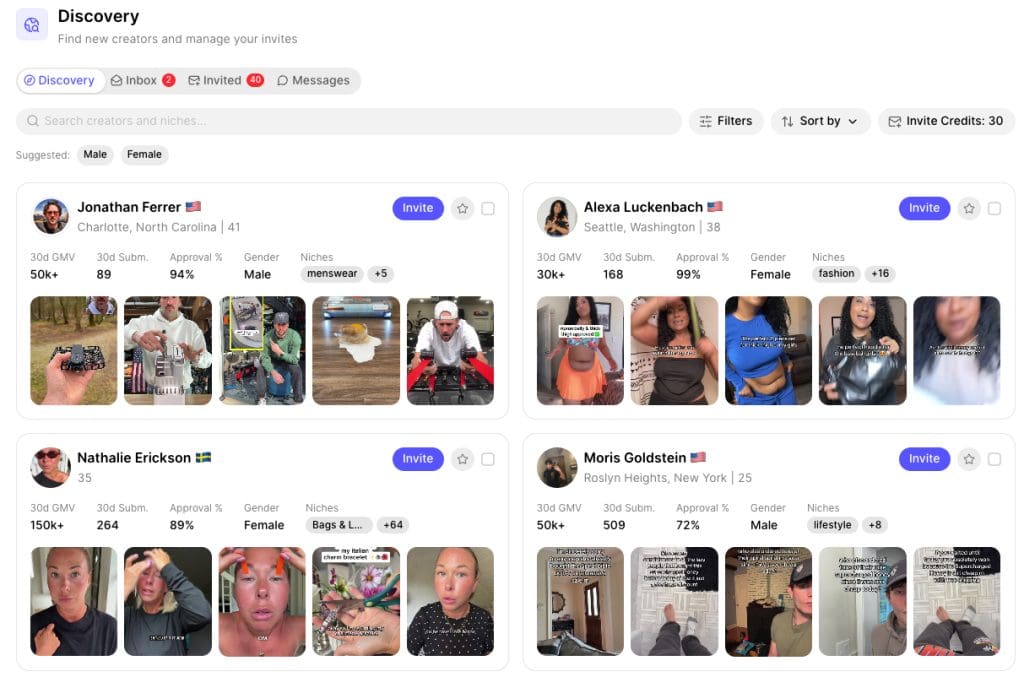
Why the model is smart
It flips the risk. Traditional UGC means paying a flat fee for every video before you know if any of them work. Trybe lets brands pay on performance instead: a percentage of attributed sales or ad spend, a flat fee, or a mix. Creators we’ve seen on the platform commonly earn 10% to 15% of GMV on content the brand runs. You pay most when a video is making you money.
It matches how Meta buys now. When creative is the targeting, the brand with 200 distinct concepts beats the brand with 20. Trybe’s model encourages creators to submit many takes, so you’re testing hooks, personas, and angles you’d never have briefed yourself.
It collapses the whitelisting bottleneck. Getting creator ad permissions is usually a chain of DMs and access requests. Here it’s built into the approval step, so a winning video can be live as a Partnership Ad the same day.
The platform fee is low. Trybe is free to start with no seats, contracts, or minimums, and its fee tops out at 1.5%. The full cost picture is in the next section.
The results brands report are big. Trybe’s own case studies show Final Boss Sour going from $300K to $2.1M a month in Meta-attributed revenue while CPA dropped from $35 to $20, and JiYu scaling DTC revenue from $50K to $2.5M a month in six months. Treat vendor case studies as best cases, not benchmarks. They still show what the ceiling looks like.
What Trybe actually costs a brand
Trybe’s platform fee is small, but it isn’t the whole bill. Here’s what a brand actually pays.
1. Trybe’s platform fee. One rate, based on how you pay creators, never stacked:
How you pay creators | Trybe’s fee |
|---|---|
Commission on sales | 1.5% of attributed sales |
Commission on ad spend | 1.25% of ad spend |
Flat fees, retainers, or bonuses | 1.5% of creator earnings |
2. Creator pay. This is the biggest line item. Creators commonly earn 10% to 15% of the sales their content drives, and you set the rate.
3. Ad spend. Creator videos earn most of their money as paid ads, so budget to run and scale the winners.
4. Product. Free samples shipped to every creator you accept.
5. Team time. Someone has to review submissions, give feedback, check compliance, and launch ads. At hundreds of videos a month, that’s a real workload.
A simple example: creator ads drive $50,000 in sales at a 10% commission. The brand pays $5,000 to creators and $750 to Trybe, plus the ad spend behind those sales and the cost of samples. The difference from traditional UGC is that you pay as results come in, not before.
Why the timing matters: holiday 2026 and 2027
For holiday, the window is now, and it’s short. A creator program needs time to ramp: recruiting creators, shipping samples, collecting submissions, and testing enough ads to find winners. If you want proven creative scaling into Black Friday and Cyber Monday, you need to launch in early October. Start in mid-November and you’re testing when you should be scaling.
Holiday demands more creative, not less. CPMs climb, audiences see more ads, and fatigue hits faster. Gift-angle, bundle, and offer-specific creative all need fresh variations. A performance-paid creator bench is the most cost-efficient way we know to refill the pipeline weekly without a production budget spike.
For 2027, it’s infrastructure. The brands that build a creator bench this quarter walk into January with hundreds of tested concepts, data on which angles and personas convert, and a roster of proven creators. That compounds. Brands that wait will be starting cold while their competitors are iterating on winners.
Where it breaks
Trybe is a tool, not a strategy. You still need a creative strategist guiding your creators and running and optimizing your ads, videos, statics and entire funnel strategy. The same features that make it powerful create predictable failure modes:
- Volume without direction. Creator reviews note that some brands seem to want lots of drafts and care less about quality or original ideas. Without sharp briefs and clear creative angles, you get 300 versions of the same mediocre video.
- Approved but never run. Creators report brands approving videos and then sitting on them for months. That kills your reputation on the platform, and the best creators stop submitting.
- Saturation on popular programs. Big brands attract thousands of creators. One creator noted Cuts Clothing had roughly 3,200 accepted creators and 7,300 submissions. Standing out as a brand requires responsive communication, fast approvals, and fair commissions.
- Attribution is a choice, not a truth. Trybe’s server-side last-click model is useful, but it will disagree with Meta’s reporting. Decide up front which model you pay creators on, and stick to it.
- Meta-first. The ad-launching workflow is built around Meta. If TikTok or YouTube is your main channel, plan for manual steps.
None of these are reasons to skip it. They’re reasons to run it with a system.
Supplement and regulated brands: scale the creative, not the risk
This is the part most Trybe coverage skips. When a brand runs a creator’s video as an ad, the brand owns every claim in it. For supplement, wellness, and CPG brands, that matters a lot. (It’s why we built our supplement marketing practice around compliance.)
Hundreds of creators improvising scripts will produce disease claims (“cured my anxiety”), unsubstantiated results (“lost 20 pounds in a month”), and missing endorsement disclosures. Each one is an FTC or FDA exposure the moment it’s whitelisted, and the brand is the one on the hook.
The fix is a compliance layer built into the workflow, before anything reaches Meta:
- Briefs that spell out approved structure/function language and banned claim types.
- A claims review on every submission before approval, not after launch.
- Clear disclosure requirements for Partnership Ads and any organic cross-posting.
- A “do not run” library so creators learn the boundaries fast.
Done right, compliance doesn’t slow a creator program down. It keeps your winning ads from getting pulled at the worst possible moment.
How Forge runs Trybe programs
Forge manages Trybe creator programs for DTC brands as part of our influencer marketing services, and our team includes active Trybe creators, so we see the platform from both sides. We handle the parts that decide whether a program works:
- Program design: commission structure, product selection, and creator recruiting criteria.
- Creative direction: briefs built from your best-performing angles, updated weekly from submission data.
- Compliance review: claims and disclosure checks on every submission, built on 10+ years of brand-side supplement experience.
- Media buying: launching, testing, and scaling winners in Meta alongside your existing account structure.
- Creator management: fast approvals and responsive communication, so top creators keep choosing your program.
If you want proven creator ads running by Black Friday, the time to start is this month.
Start your Trybe program here, or book a call with Forge and we’ll build it with you.
Disclosure: Forge Digital Marketing is a Trybe agency partner, and the link above is our referral link. We may earn a commission or credit if you sign up through it. Trybe is free to join either way.