
TL;DR
Dynamic content transforms generic email blasts into personalized experiences that feel tailor-made for each subscriber. Instead of creating dozens of separate emails, dynamic content uses Klaviyo’s conditional logic to adjust messaging, product recommendations, and offers based on each recipient’s behavior, purchase history, or profile data. At Forge, we use dynamic blocks to deliver the right discount tier, product reminders, and educational content to each segment, lifting engagement metrics while keeping your email production lean and scalable.
Key Points
• Dynamic content adjusts email messaging, visuals, and offers based on recipient behavior and profile data without creating separate versions for each segment.
• Performance gains include higher click-through rates, increased revenue per recipient, fewer unsubscribes, and reduced long-term production time once blocks are configured.
• Post-purchase sequences use conditional blocks to show product-specific usage tips and habit-building advice that sync with each customer’s exact purchase.
• Tiered discount strategies display the most relevant offer based on subscriber segments, maintaining profitability while increasing AOV for specific groups.
• Starting small with one dynamic element like product blocks or discount banners makes implementation manageable while you learn and test effectiveness.
By Rakel Abreu, Graphic Design Strategist at Forge Digital Marketing
About the Author
Rakel Abreu is a Graphic Design Strategist at Forge Digital Marketing. With a background in Branding and UX/UI Design, she specializes in email design, campaign creative strategy, and conversion-focused creative that blends brand storytelling with smart segmentation.
Email has always been a powerful tool for building customer relationships. But today, relevance is the new currency. As inboxes get more crowded, simply broadcasting messages isn’t enough. You need to deliver value that feels personal, timely, and aligned with each subscriber’s needs. That’s where dynamic content comes in.
In this article, I’ll walk you through what dynamic content really means in practice, why it matters, and how brands can apply it in Klaviyo to build smarter, higher-converting emails. I’ll also break down a real example we created at Forge Digital Marketing to show you exactly how it works.
What is Dynamic Content?
Dynamic content is email content that changes depending on who is receiving it. Instead of creating separate emails for each customer group, dynamic content allows you to create one email that adjusts its messaging, visuals, and offers based on the recipient’s profile, behavior, or past actions.
This can include:
- Product recommendations based on browsing or purchase history
- Conditional discount codes depending on cart size
- Region-specific messaging
- Loyalty-tier benefits or status
- Behavioral logic (e.g., hiding content if someone already purchased)
The goal? Give every subscriber a message that feels tailored to them, without overwhelming your marketing team with dozens of email versions.
Why Dynamic Content Is Worth the Effort
When used well, dynamic content lifts every core email performance metric:
- Higher click-through rates: Relevant product suggestions or promotions increase engagement.
- Increased revenue per recipient: Personalized blocks often drive stronger conversions.
- Fewer unsubscribes: Content that feels useful or timely encourages subscribers to stay.
- Less production time long term: Once your dynamic blocks are set up, you can reuse them across campaigns and flows.
And thanks to platforms like Klaviyo, implementing this doesn’t require advanced coding. Most blocks can be configured using built-in conditions and data tags.
Real-World Example 1:Leveraging dynamic content blocks in Klaviyo for personalized post‑purchase sequences
One of the easiest ways to boost engagement and reduce unsubscribes in your post‑purchase flow is to show each customer only the content that matters to them.
Klaviyo’s dynamic content blocks let you do exactly that—without building dozens of separate flows. Here’s how we used them in a recent supplement‑brand sequence for our dietary supplement client, Innerbody Labs.
Post‑purchase email 1: “Your routine starts today”
- What we wanted: A single template that changes based on which product a customer bought.
- How we built it:
- Testosterone-support block
- Testosterone-support block
- What we wanted: A single template that changes based on which product a customer bought.
- Show this block only when Product purchased equals Testosterone Support.
- Focus-support block
- Focus-support block
- Show this block only when Product purchased equals Focus Support.
- General block
- Show when neither of the above conditions is met.
- Show when neither of the above conditions is met.
- Personalized greeting
- Default to “Hi, there,” but swap in “Hi, {{ first_name }},” if we have the subscriber’s first name.
- Default to “Hi, there,” but swap in “Hi, {{ first_name }},” if we have the subscriber’s first name.
- General block
Result: One email template that greets each shopper by name (when known) and delivers only the product‑specific usage tips they need—no irrelevant advice, no extra clutter.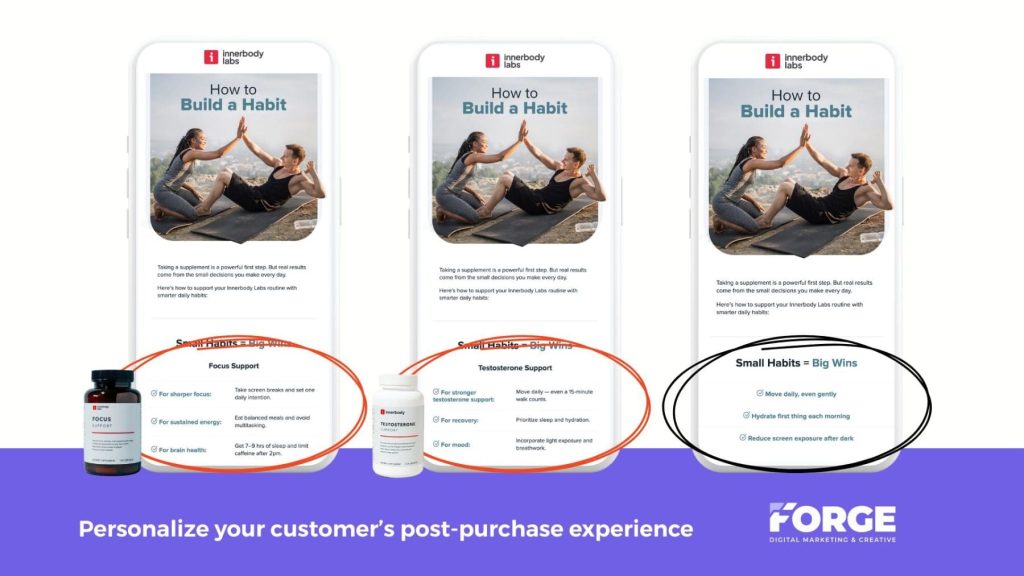
Post‑purchase email 2: “How to build a habit”
- What we wanted: A follow‑up email that continues to feel tailor‑made, even as the product catalog grows.
- How we built it:
- Testosterone-support block
- Testosterone-support block
- What we wanted: A follow‑up email that continues to feel tailor‑made, even as the product catalog grows.
- Display if Testosterone Support was purchased.
- Focus-support block
- Focus-support block
- Display if Focus Support was purchased.
- Sleep-support block
- Sleep-support block
- Display if Sleep Support was purchased.
- General block
- Display if none of the above products were purchased.
- Display if none of the above products were purchased.
- General block
Result: Whether someone bought one supplement or several, they see only the habit‑building tips that sync with their routine—driving higher click‑through rates and fewer one‑size‑fits‑all complaints.
Why’d we do this?
- Maintain one flow, not one per SKU. Dynamic content blocks keep your flows lean and easy to update.
- Reduce irrelevance. Customers are more likely to read and act when every tip applies to their exact purchase.
- Scale effortlessly. As you add new products, simply add a new block with its own “display if purchased” condition—and you’re done.
By making every post‑purchase email feel one‑to‑one, you build trust faster, drive more repeat purchases, and showcase your brand’s commitment to personalization.
Real-World Example 2: Showing Promotional Offers Conditionally Based on Personalized Customer AOV & Purchase Behavior
To bring this to life, I want to share a campaign I designed here at Forge Digital Marketing for a client working to serve children on the autism spectrum.
The goals were twofold: promote relevant products to the client’s subscriber base while also retaining profitability by only showing deep discounts to users who required them in order to increase AOV for certain segments.
Here’s how we used dynamic content to deliver on both fronts:
- Tiered Discounts Based on Order Value
- We offered three discount codes: $5 off $50, $15 off $125, and $30 off $200.
- Using conditional blocks in Klaviyo, only the most relevant offer was shown depending on the subscriber segment (e.g. average order value or past purchase behavior).
- We offered three discount codes: $5 off $50, $15 off $125, and $30 off $200.
- Dynamic Product Recommendations
- The email included products like SpectrumNeeds Powder and Enhansa 150mg.
- These were dynamically pulled in using Klaviyo’s product feed and merchandising rules.
- The same email could show a slightly different lineup to a new customer vs. a repeat buyer.
- The email included products like SpectrumNeeds Powder and Enhansa 150mg.
- Purpose-Aligned Messaging
- We connected product promotions with the broader mission of Autism Awareness.
- Supporting content blocks highlighted how specific supplements aid neurological or dietary needs common in individuals with autism.
- We connected product promotions with the broader mission of Autism Awareness.
- Loyalty Program Integration
- A section highlighted the brand’s reward program.
- This content can be dynamically replaced or suppressed based on loyalty tier or whether someone has already joined.
- A section highlighted the brand’s reward program.
- Localized Compliance Message (Optional)
- A disclaimer about FDA evaluation was included. This can also be dynamically hidden for international audiences where not legally required.
- A disclaimer about FDA evaluation was included. This can also be dynamically hidden for international audiences where not legally required.
Here are a few more examples of easy starter dynamic content ideas for your ecommerce or Shopify brand:


- Tailored coupon codes
Inspired by my “Don’t miss out!” promo
I’ll admit—I get a kick out of showing subscribers exactly the offer they deserve. In this template, I created three tiny content blocks:
- VIP savers: “Display if subscriber is in VIP segment,” then drop in {{ coupon_vip }}.
- New‑buyer nudge: “Display if First Purchase Date is null,” then show {{ coupon_new }}.
- Everyone else: A fallback block with {{ coupon_general }}.
No more “one‑size‑fits‑all” codes—each shopper sees the perfect discount for their profile.
- Cart‑specific product reminders
Inspired by my Abandoned Cart flow
Nothing kills momentum like a generic “You left items in your cart” message. Instead, I use Klaviyo’s Abandoned Cart product block and style it to show only the exact SKU they clicked “Add to cart” on. Here’s how:
- Drag in a Product block, set to “Display when {{ event.extra.line_items }} exists.”
- Limit it to a single tile (or a swipe‑carousel for multiple items).
- Tweak the fonts and button to match your brand.
Result? Shoppers get a crystal‑clear reminder of their almost‑theirs item—and a perfectly placed “Return to cart” button.
- Replenishment + best‑sellers combo
Inspired by my “Explore the favorites” restock email
For subscription or repeat‑buy brands, I fuse two feeds in one email:
- Your recent purchase: A horizontal row populated by filtering Event: Placed Order → Last 30 days → Limit 1.
- Our top sellers: A dynamic grid pulling from a Shopify “best_sellers” tag or Klaviyo product feed.
Both blocks live in the same template but only render for engaged subscribers—so you remind them to reorder their go‑to supplement while teasing what everyone else loves right now. It’s like an upsell and cross‑sell on autopilot.
Give these a whirl in your next Klaviyo build—blend, test, and watch your engagement climb.
Tips for Building Dynamic Content in Klaviyo
- Start small. Add dynamic logic to one part of your email: like a product block, discount banner, or CTA.
- Use conditional splits in flows. Create variations based on behavior, cart value, or user status.
- Test & preview. Klaviyo’s preview tool lets you see what each variant will look like for different segments.
- Leverage profile properties. Capture key data like location, birthday, preferences or loyalty status to personalize emails over time.
- Track performance separately. If you’re using dynamic blocks, tag or segment the campaign so you can analyze effectiveness by version.
The Bottom Line
Dynamic content is all about achieving extreme relevance. And in email marketing, relevance is what drives results.
Whether you’re promoting a product, a mission, or both—personalizing your message at scale ensures your brand shows up with meaning in every inbox.
If you’re looking to build smarter, higher-performing campaigns, we’re here to help. At Forge Digital Marketing, we help brands like yours put these strategies into action with custom Klaviyo builds, dynamic content design, and data-driven flows that convert.