
Table of Contents
ToggleAuthor: Erin Schnittker Siemek, Founder & CEO, Forge Digital Marketing
Last updated: October 2026
The short answer: Keep Meta ads in-house if your problem is execution and your spend can fund both a full-time buyer and a steady supply of new creative. Hire an agency if the problem is creative strategy, tracking or compliance, or if your spend can’t yet justify a dedicated team. Figure out which problem you have before you hire anyone.
Most founders start by comparing salaries to retainers. Start with the account. Tired creative and broken tracking produce the exact same falling ROAS, yet each needs a different person to fix it. If you hire the wrong kind of help… you’ll pay for three or four months before anyone notices the real issue.
Assess your current performance and internal capacity
Two questions decide this: what is actually broken, and does your team have the hours and skills to fix it? Answer the first one before you touch the second. A lot of “we need an agency” moments turn out to be a creative problem or a tracking problem wearing a disguise.
Read the funnel in order
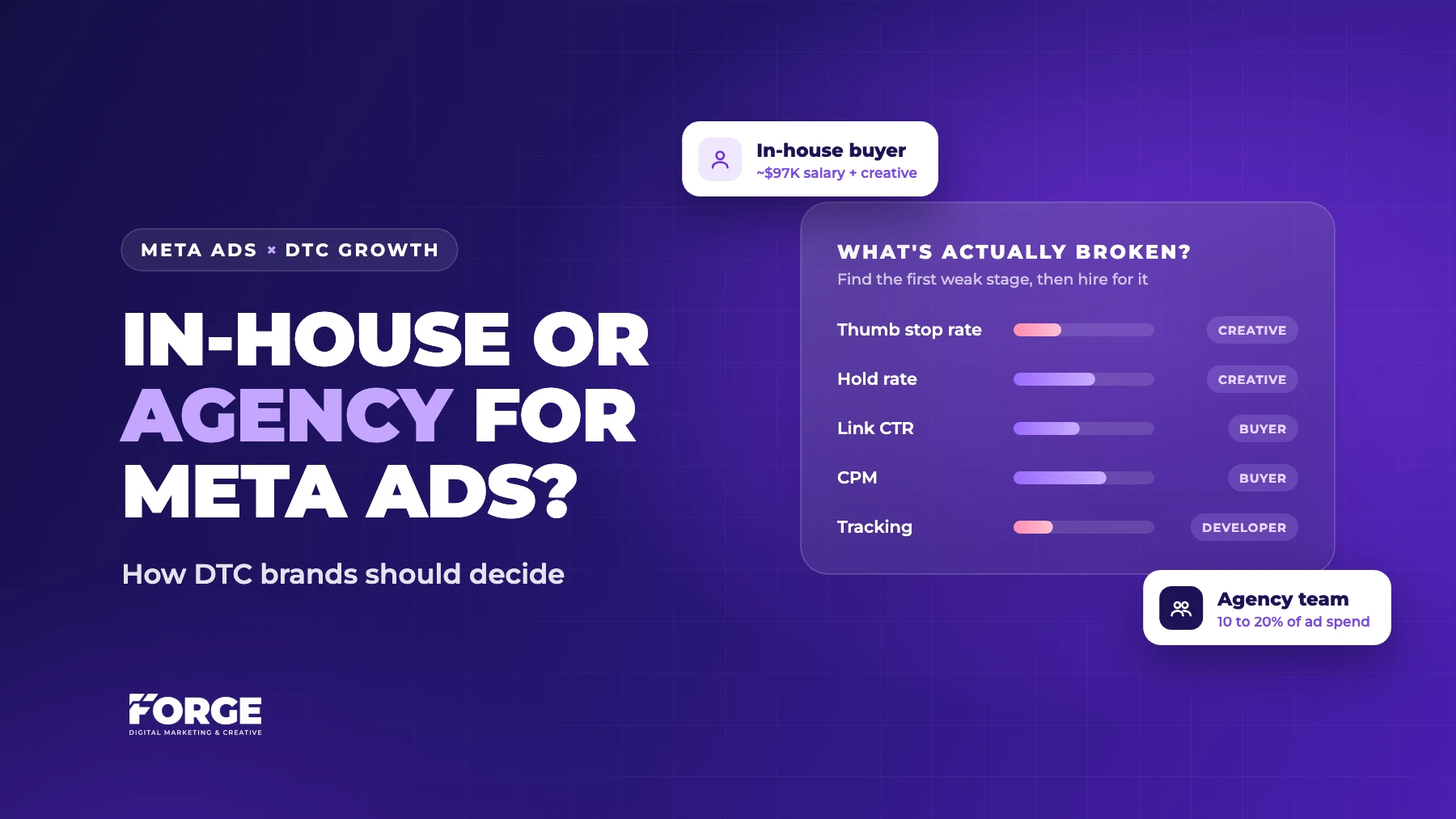
Meta performance breaks at a specific stage. Find the first weak stage.
| Metric | What it tells you | If it’s weak, the fix is | Who usually fixes it |
|---|---|---|---|
| Thumb stop rate (3-second video plays ÷ impressions) | Whether the first frame stops the scroll | New hooks and opening shots | Creative strategist + editor |
| Hold rate (15-second plays ÷ 3-second plays) | Whether the story keeps attention | Script and pacing | Creative strategist |
| Link click-through rate | Whether the ad makes a promise worth clicking | Angle, offer, call to action | Creative + media buyer |
| Landing page conversion rate | Whether the page delivers on the ad | Page, offer, reviews, price | Ecommerce/CRO team |
| CPM | What the auction is charging you | Account structure, audience, seasonality | Media buyer |
| Meta purchases vs. Shopify orders | Whether your tracking is accurate | Pixel + Conversions API setup, deduplication | Technical specialist or developer |
A media buyer owns two of those six rows. So when a brand hires one person to “fix Meta” and the real break sits in creative or tracking, that hire can work hard for months and move nothing.
What a ROAS drop usually means
Check these causes in this order, because the first is the most common and the cheapest to confirm:
- Creative fatigue. Frequency on your top-spend ads climbs while thumb stop rate and CTR slide. You need new creative. New targeting won’t help.
- Tracking loss. Meta-reported purchases drift away from Shopify orders over the same date range. If that gap widened, Meta is under-counting, and your ads may be performing fine.
- A change on the site or the offer. CTR holds steady while conversion rate drops. Look at what changed after the click: price, stock, page speed, a new checkout app.
- Auction pressure. CPMs rise across every ad at once. Q4 and big sale weekends do this every year.
Compare like-for-like windows. If someone restructured the account halfway through a 90-day period, the average blends two strategies into one misleading number. Put the 30 days before the change next to the 30 days after.
Audit your team’s capacity
For a brand spending $20,000 to $100,000 a month, a typical week of Meta work looks like this:
- Daily monitoring: 30 to 60 minutes a day on pacing, rejected ads and budget shifts
- Test analysis and planning: 3 to 5 hours reading results and choosing what runs next
- Creative production: 10 to 20 hours of briefing, creator sourcing, editing and design
- Reporting: 2 to 3 hours tying Meta numbers back to Shopify
Most in-house plans budget for the first two lines and forget creative production entirely. The buyer gets hired, runs out of new ads to test by week six, and starts tweaking audiences instead.
Compare the true cost
Ad spend is excluded from every figure below.
| Option | Typical cost | What you get | Main risk |
|---|---|---|---|
| In-house media buyer | About $97,000 average US salary (Glassdoor, via Superscale), roughly $10,000 to $11,000 a month once payroll taxes and benefits are added | Full-time attention and deep brand knowledge | One person’s skill set; creative and tools cost extra; a resignation resets the account |
| Freelancer | $15 to $40 an hour on Upwork, $25 median (Superscale) | Flexible, low-cost execution | Limited hours; rarely covers creative or tracking |
| Agency | 10 to 20% of monthly ad spend, or a flat retainer (Superscale, citing WebFX and Clutch) | A team: buyer, creative strategist, designers, analyst | Less brand intimacy; quality varies widely |
Run the crossover math on your own spend. At $50,000 a month, a 10 to 20% agency fee comes to $5,000 to $10,000, which is about what a single in-house buyer costs before you’ve paid for one piece of creative. Past roughly $100,000 a month, many brands go hybrid. An in-house growth lead owns strategy and the numbers, and an agency or creative studio handles production.
In-house usually wins when your spend covers a buyer plus a creative pipeline and your tracking is already clean.
An agency usually wins when the break is in creative or tracking, or when you sell supplements and every ad has to clear health-claim rules before it runs.
Define your requirements for an agency partner
Pick the agency built to fix the problem you just diagnosed. A shop with great media buyers and a thin creative bench won’t rescue an account whose hooks have gone stale. Write down your top two problems and score every agency against them. (Our guide to choosing a DTC ecommerce marketing agency covers the broader evaluation.)
If you sell supplements or wellness products
Supplement ads answer to two rulebooks at once. An agency fluent in only one will get your ads rejected or put your brand in front of a regulator.
- Meta’s ad policies. Meta rejects ads that assert or imply the viewer has a health condition. “Struggling with brain fog?” gets flagged; “Built for focus on long workdays” runs. Before-and-after imagery and weight-loss claims carry extra restrictions on top of that.
- Federal law. The FTC expects competent and reliable scientific evidence behind every health claim, and it treats a creator’s testimonial as your claim (paid partnerships also need clear disclosure). The FDA draws the other line: a disease claim like “treats anxiety” turns a supplement into an unapproved drug, while a substantiated structure/function claim like “supports healthy focus” is allowed.
In the pitch meeting, hand the agency a disease claim and ask them to rewrite it into a compliant structure/function claim on the spot. Ask who reviews creator scripts before launch. You want names and a process. If they need to get back to you, they haven’t done this much.
If you’re a Shopify brand scaling past $1M
Past $1M the question changes from “can Meta drive sales” to “are these sales real and profitable.” Require:
- Server-side tracking. Meta’s Conversions API running alongside the pixel, with deduplication checked. Browser-only tracking under-counts purchases.
- Blended reporting. Marketing efficiency ratio (total revenue ÷ total ad spend) and new-customer acquisition cost, alongside Meta-reported ROAS. Meta’s purchase count and Shopify’s will never match exactly, and your agency should be able to explain the gap.
- Creative throughput. A repeatable monthly process for producing and testing new concepts. Spend only scales as fast as winning creative does.
- Attention past the first order. Acquisition costs pay back when customers buy again, so an agency that ignores email and SMS retention is optimizing half the equation.
Questions to ask any agency
| Ask this | A strong answer | A red flag |
|---|---|---|
| How do you decide which creative gets more budget? | Named metrics, thresholds and a testing cadence | “The algorithm decides” |
| Who makes the creative? | An in-house team or vetted creators, briefed per concept | “You send us the assets” |
| What do you report, and how often? | Thumb stop, hold rate, CTR, CPA and blended MER, reconciled to Shopify | A screenshot of Meta ROAS |
| Who owns the ad account and pixel? | You do; the agency gets partner access | It runs inside the agency’s own Business Manager |
| Can I see results for a brand like mine? | A named case study with before-and-after numbers, or a client reference call | Percentages with no client, timeframe or spend |
| What’s the contract term? | A defined term with a clear exit clause | A long lock-in with no way out if results miss |
Establish a budget and performance expectations
Settle the money and the metrics before anyone launches an ad. Agency relationships usually sour around month three, and the cause is almost always expectations nobody wrote down.
What is a good thumb stop rate on Facebook ads?
A good thumb stop rate on Facebook and Instagram video ads is 25 to 35%. Above 35% is strong. Below 25%, the opening needs work. Thumb stop rate (also called hook rate) is 3-second video plays divided by impressions, times 100, and it tells you whether the first moments of an ad stop someone mid-scroll.
| Thumb stop rate | What it means | What to do |
|---|---|---|
| Below 25% | The opening isn’t stopping the scroll | Test new first frames and opening lines |
| 25 to 35% | Solid, with room to improve | Keep the concept and iterate on the hook |
| Above 35% | The hook is working | Check hold rate and CTR before you scale it |
These ranges come from Motion’s creative metrics guide, which also puts average hold rate at 40 to 50% and average Meta CTR at 0.9 to 1.5%.
Across the accounts Forge manages, our best-performing video creative lands somewhere between 30% and 60%. Read the benchmark with two cautions.
- Thumb stop alone can mislead you. One health brand’s video hit a 99% thumb stop rate and a 0.13% CTR. Nearly every viewer paused on it, and almost none clicked. Always read thumb stop beside hold rate and CTR.
- It only measures video. Static images don’t register 3-second plays, so judge statics on CTR and cost per purchase. Autoplay behavior also differs by placement, which is why you should compare creative against creative in the same placements before you compare against any industry average.
How many ad creatives should you test per month on Meta?
The number comes out of your budget. Every test needs enough spend to produce a readable result, so use this:
Creatives you can test each month = monthly testing budget ÷ (2 to 3 × your target cost per purchase)
Take a brand spending $20,000 a month. It puts 20% ($4,000) toward testing and targets a $50 cost per purchase. That budget supports roughly 27 to 40 ads read on purchase data, which usually means 6 to 10 concepts with a handful of hook variations each. Thumb stop and CTR give you an early signal within a few days. Purchases make the final call.
Meta’s delivery system needs about 50 optimization events per ad set within a week to exit its learning phase. Spread a small budget across too many ad sets and every one of them stays stuck in learning, so consolidate tests into fewer ad sets with real budgets behind them.
How much should you pay an agency to manage Facebook ads?
Most agencies charge 10 to 20% of monthly ad spend, a flat monthly retainer, or a base fee plus a percentage, with ad spend billed separately. Clutch puts the average social media marketing retainer at about $5,108 a month (via Superscale).
Get these answers in writing before you sign:
- Is creative production included, and is it capped?
- Does the fee rise automatically as spend grows?
- Are tracking fixes and landing page work billed separately?
- Who owns the creative files if you part ways?
Why your Meta ads aren’t converting (supplement brands)
Clicks without purchases on a supplement account usually trace back to one of these:
- The page is vaguer than the ad. Compliance edits watered down the landing page copy until it no longer matches the promise that earned the click. Make the ad and the page carry the same claim and the same offer.
- Nothing on the page builds trust. People treat supplements as a trust purchase. Put third-party testing, ingredient sourcing, dose per serving and real reviews where shoppers see them without scrolling.
- Subscription friction. Forcing a first-time buyer into a subscription kills conversion. Offer a one-time purchase with subscribe-and-save as the option.
- Meta can’t see the sales. When the Conversions API is missing or misconfigured, purchases happen off Meta’s radar and the algorithm optimizes toward the wrong people.
What reporting should look like
Ask for a weekly scorecard that repeats the same metrics every time: spend, purchases, cost per purchase, thumb stop rate, hold rate, CTR and blended MER reconciled to Shopify. Then one or two lines on what was tested and which version won. A report that only lists results leaves you guessing whether anyone is steering the account.
How Forge runs Meta ads
Forge Digital Marketing is a boutique growth agency for DTC ecommerce brands, with deep roots in supplements and wellness. We run paid media on Meta and Google (TikTok too, when the product fits) and tie it to the email, SMS and Shopify work that decides whether a new customer ever turns a profit.
Our Meta method starts with the hook. We find the opening that stops the scroll, prove it converts to purchases, then move budget onto it and cut what doesn’t earn its spend. Static creative and design come included in management, built each month around the testing roadmap instead of a fixed number of deliverables.
At Batch Balance, one month of that approach produced these numbers:
| Metric | Before | After one month |
|---|---|---|
| ROAS | 2.34x | 4.29x |
| Cost per purchase | $36.81 | $22.80 |
| Thumb stop rate | 14.3% | 31.2% |
| Purchases | 79 | 170 |
| Ad spend | $2,908 | $3,876 |
Spend went up 33% while purchases went up 115%.
Weighing an in-house hire against an agency? We’ll audit your account and tell you which problem you actually have, including when the honest answer is to hire in-house. See how we run Facebook and Instagram ads, or book a discovery call with Carolynn Poulsen.
Frequently asked questions
Should I hire an agency or fix my Facebook ads in-house after a ROAS drop?
Start by comparing Meta purchases to Shopify orders, then check frequency, thumb stop rate and CTR on your top-spend ads. If creative fatigue or broken tracking caused the drop, an agency with creative and technical depth will usually fix it faster than a new hire.
Is it cheaper to hire an in-house media buyer or an agency?
Below roughly $50,000 a month in ad spend, an agency usually costs less once you count creative production. An in-house media buyer averages about $97,000 a year in salary, before benefits, tools or creative.
What is a good hook rate for Meta video ads?
Hook rate is another name for thumb stop rate. 25 to 35% is solid, above 35% is strong, and anything under 25% means the opening needs work.
How many creatives should I test on Meta each month?
Divide your monthly testing budget by two to three times your target cost per purchase. A $4,000 testing budget at a $50 target supports roughly 27 to 40 ads.
What should a supplement brand look for in a Meta ads agency?
Fluency in Meta’s health ad policies and in FTC and FDA claim rules, plus a named person who reviews creator scripts before launch. Ask to see case studies from ingestible or wellness brands.
How much do Facebook ad agencies charge?
Most charge 10 to 20% of monthly ad spend, a flat retainer, or a base fee plus a percentage. Ad spend is billed separately.
Sources
- Motion: Key creative performance metrics (thumb stop, hold rate and CTR benchmarks)
- Superscale: Meta ads management cost, updated July 23, 2026 (agency fee ranges from WebFX, Clutch retainer average, Upwork freelancer rates, Glassdoor media buyer salary)
- Forge: Batch Balance Meta ads case study (before and after account figures)
- Forge client ad accounts in Meta and Motion, September 2026 (the 30 to 60% thumb stop range and the 99% thumb stop / 0.13% CTR example, anonymized)