
Author: Erin Schnittker Siemek, Founder & CEO, Forge Digital Marketing
Last updated: October 2026
Choosing the right digital marketing agency for your direct-to-consumer (DTC) brand isn’t about finding the agency with the biggest client roster or the most impressive promises. It’s about finding a team that understands how ecommerce businesses grow—and knows how to connect customer acquisition, conversion, and retention into one coordinated strategy.
For Shopify and other ecommerce brands, that means thinking beyond individual marketing channels.
Your Meta Ads strategy influences which customers discover your products. Your website determines how effectively that traffic converts. Your Klaviyo email and SMS programs help customers return. And your SEO strategy creates additional opportunities for shoppers to find your business without relying exclusively on paid advertising.
The right DTC marketing agency understands how these activities influence one another and can demonstrate that expertise through real work.
At Forge Digital Marketing, we specialize in helping ecommerce brands connect paid media, organic search, conversion optimization, and customer retention.
This guide explains what to look for in an ecommerce marketing partner, which questions to ask before hiring an agency, and how to distinguish genuine expertise from attractive reporting dashboards.
1. Choose an Agency That Understands the Entire Ecommerce Customer Journey
A successful ecommerce growth strategy doesn’t end when someone clicks an advertisement or makes their first purchase.
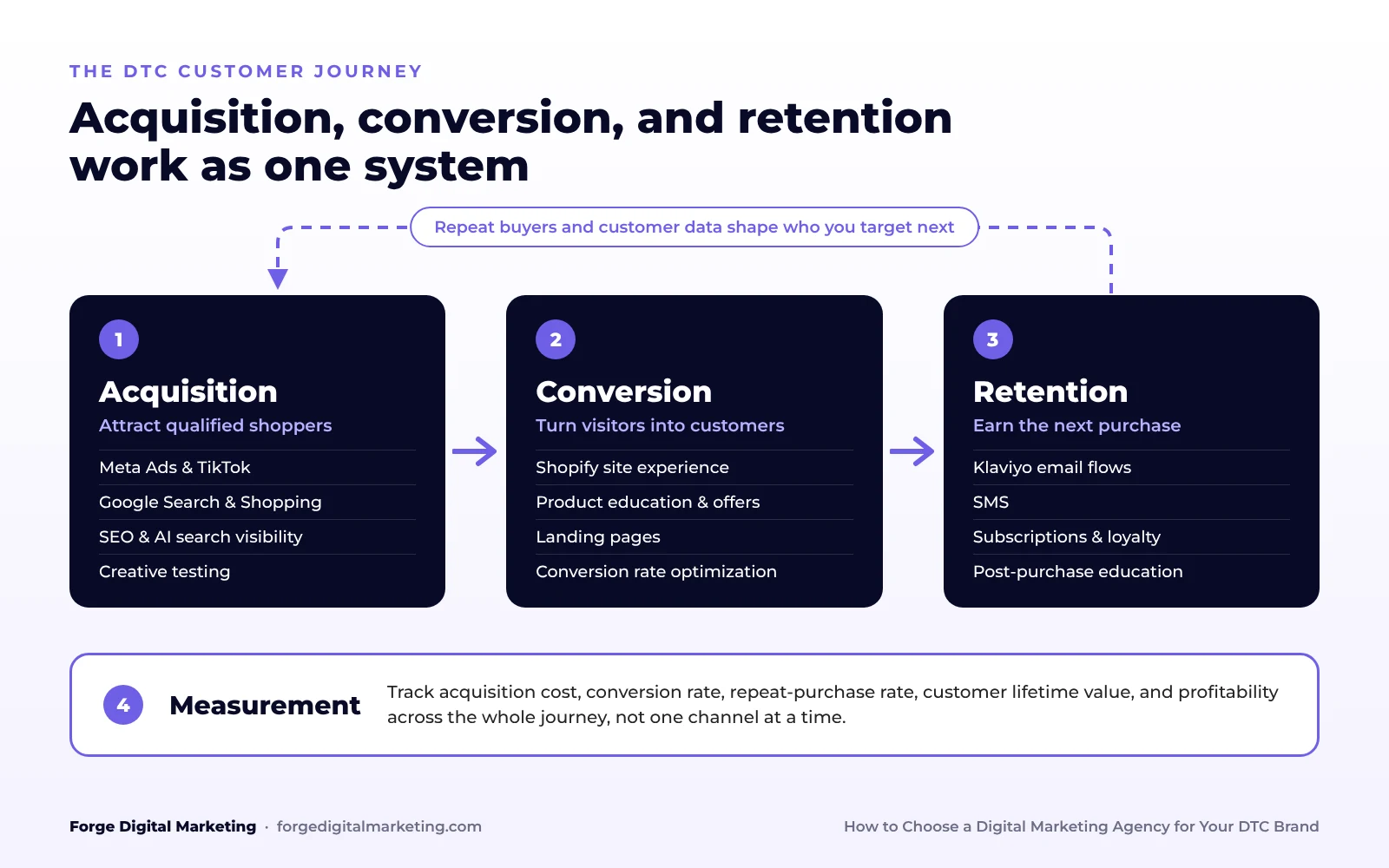
It should account for four interconnected stages.
Acquisition: Attracting qualified shoppers through Meta, Google, TikTok, SEO, and other appropriate channels.
Conversion: Turning visitors into customers through product education, compelling offers, thoughtful website design, and an optimized shopping experience.
Retention: Encouraging repeat purchases through email, SMS, subscriptions, loyalty programs, and relevant customer communications.
Measurement: Understanding how marketing investments influence acquisition costs, customer behavior, revenue, and profitability.
An agency specializing in only one channel may be excellent at its particular discipline while overlooking problems elsewhere in the customer journey.
For example, a paid media agency may increase traffic without recognizing that a confusing product page is limiting conversions.
An email marketing agency may celebrate increased attributed revenue without investigating whether the business is successfully acquiring new customers.
And a Shopify development team may build a visually appealing website without understanding the landing page requirements of paid advertising campaigns.
Why does integrated ecommerce marketing matter?
Consider a DTC skincare brand introducing a new moisturizer.
Its Meta advertising introduces the product through distinct creative concepts targeting different customer motivations.
Its Shopify landing page explains the ingredients, benefits, and product experience.
Its Klaviyo welcome sequence educates interested shoppers who haven’t yet purchased.
Its post-purchase flows provide product usage guidance, encourage appropriate replenishment, and introduce complementary products.
Meanwhile, SEO content helps prospective buyers discover the brand while researching ingredients, skincare concerns, or product comparisons.
Each channel plays a different role, but all support the same customer journey.
That’s the difference between managing marketing channels and building an ecommerce growth strategy.
2. Look for Specialized Ecommerce Email and SMS Expertise
Who offers email marketing for ecommerce brands?
Many agencies offer email marketing. Fewer have the technical and strategic expertise to build sophisticated ecommerce lifecycle programs.
For DTC brands, email and SMS should do more than announce promotions or send newsletters. They should respond to customer behavior, support purchasing decisions, and create relevant opportunities for repeat revenue.
When evaluating an ecommerce email marketing agency, look for experience with:
Welcome sequences and subscriber acquisition.
Abandoned checkout and browse abandonment automations.
Post-purchase education and product recommendations.
Replenishment reminders aligned with product consumption.
Customer segmentation and behavioral personalization.
Win-back and reactivation programs.
Subscription retention and loyalty integrations.
Deliverability, list hygiene, and consent management.
Coordinated email and SMS campaigns.
Why Klaviyo expertise matters for Shopify brands
Klaviyo is particularly useful for ecommerce businesses because it can use customer, product, and purchase data to support more relevant marketing.
However, connecting Klaviyo to Shopify doesn’t automatically create an effective retention program.
The strategy depends on how that data is used.
For example, a supplement business selling a 30-day supply may benefit from replenishment messaging based on expected consumption and purchase behavior.
A fashion retailer may benefit more from product affinity, purchase history, new collection announcements, and personalized recommendations.
A skincare business may need education-driven post-purchase flows that explain product usage before introducing additional products.
Forge Digital Marketing is a Klaviyo Master Gold Partner providing email and SMS lifecycle strategy, campaign management, segmentation, automation, deliverability support, and ecommerce integrations.
Our experience also includes connecting Klaviyo with subscription tools, loyalty systems, customer reviews, and other components of the ecommerce technology stack.
What results should an ecommerce email agency deliver?
Be cautious of agencies that guarantee a specific percentage of revenue from email.
The appropriate contribution depends on the business model, acquisition mix, customer retention patterns, and attribution settings.
In Forge’s analysis of six DTC ecommerce businesses over a 90-day period ending October 6, 2026, the median brand attributed 27.28% of its store revenue to Klaviyo. Individual brands ranged from 15.16% to 47.77%.
The important distinction is that attributed revenue isn’t necessarily incremental revenue. A customer who purchases after receiving an email might have purchased anyway.
A sophisticated agency should evaluate lifecycle performance alongside repeat purchase rate, customer behavior, and overall business growth.
Real example: Irwin Naturals
In a published Forge case study, supplement brand Irwin Naturals recorded a 157% increase in Klaviyo-attributed email revenue over 30 days.
Forge’s work included rebuilding foundational automation flows, improving customer segmentation, and introducing a more structured campaign strategy.
During the reported period, Klaviyo attributed more than $66,000 in revenue, representing approximately 28% of total store revenue.
This is an example of platform-attributed performance, not a claim that all additional revenue was caused exclusively by email.
Read the Irwin Naturals Klaviyo Case Study
3. Find a Paid Media Agency That Understands Modern Advertising Algorithms
What should a DTC brand look for in a Meta advertising agency?
Running effective Meta Ads requires more than knowing how to configure campaigns, select audiences, and adjust budgets.
Modern advertising platforms increasingly rely on machine learning to identify which advertisements are most relevant to individual users.
That makes creative strategy, testing methodology, and customer understanding essential parts of effective advertising management.
One of the recurring problems Forge identifies during Meta Ads account audits is a lack of meaningful creative diversification.
We’ll encounter accounts with only four or five advertisements running, sometimes consisting of nearly identical product images or minor headline variations.
The problem isn’t simply that there aren’t enough advertisements.
It’s that the account lacks sufficiently different creative concepts to discover what resonates with different customer motivations.
How Meta’s Andromeda system changes creative strategy
Meta’s Andromeda ad retrieval system is part of the infrastructure used to identify potentially relevant advertisements before later ranking and delivery decisions.
As Meta’s AI-powered advertising technology has evolved, developing genuinely diverse advertising creative has become an important component of campaign strategy.
However, creative diversification doesn’t mean producing dozens of slightly modified advertisements.
An effective creative testing program explores distinct approaches, such as:
Different customer personas: Who needs the product, and what motivates them?
Different pain points: Which problems or frustrations influence purchase decisions?
Different hooks: Which opening messages capture attention?
Different formats: Founder-led videos, demonstrations, UGC, testimonials, lifestyle imagery, and static product advertisements.
Different value propositions: Quality, convenience, product formulation, price, functionality, or other meaningful benefits.
Different buying motivations: Practical solutions, emotional benefits, social proof, or educational content.
Consider a skincare brand.
One advertisement might feature the founder explaining why the product was developed.
Another might demonstrate its texture and application.
A third might use customer-generated footage to communicate how the product fits into a daily routine.
A fourth might focus on a particular ingredient and its role in the formula.
These advertisements aren’t just aesthetic variations. They explore distinct reasons someone might become interested in the product.
Creative volume matters, but creative differentiation is what makes that volume useful.
The appropriate number of creative concepts depends on the brand’s budget, audience, and testing capacity. More advertisements are not automatically better if the account lacks sufficient delivery or data to evaluate them.
Does a DTC brand need separate top-, middle-, and bottom-of-funnel advertising?
The customer journey should influence advertising messaging, but it doesn’t always require a separate campaign for every stage.
Forge regularly encounters accounts that fail to account for the differences between first-time prospects, interested shoppers, and customers already considering a purchase.
An effective full-funnel strategy should understand these distinctions.
Top of funnel: Awareness
Introduce the brand, explain the product, demonstrate its benefits, and connect with customer problems.
Middle of funnel: Consideration
Answer common questions, explain product differentiators, demonstrate use cases, and introduce credible customer experiences.
Bottom of funnel: Conversion
Address remaining purchasing objections through relevant offers, product details, shipping information, guarantees, and other decision-support content.
Retargeting: Re-engagement
Reconnect with people who have previously interacted with the brand or its products, where audience size, privacy requirements, and campaign economics support doing so.
These categories can overlap. Retargeting describes re-engaging an existing audience, while funnel stages describe where someone is in the purchasing journey.
Under Meta’s increasingly automated delivery systems, broader targeting and consolidated campaigns may be appropriate. Dedicated retargeting campaigns or segmented audience structures should be justified by the account’s needs rather than applied as universal rules.
The real objective is to create messaging that addresses different levels of customer awareness and purchase intent.
Who should produce the advertising creative?
This is an important question to ask when evaluating a Meta advertising agency.
Some agencies manage the advertising account but expect the client to supply every image, video, and creative variation.
Others provide creative production as part of their advertising services.
Forge combines both approaches.
Our creative team develops original advertising assets while also using client-supplied photography, video footage, customer content, and UGC.
This allows us to build testing programs using existing brand assets while producing additional concepts when a campaign needs creative diversity.
Depending on the engagement, our process may include creative strategy, original static advertisements, video concepts, creative briefs, and variations developed from available footage.
Rather than repeatedly adjusting targeting around the same advertisements, we can investigate whether new creative approaches are needed.
Real example: Batch Balanced
Forge’s work with food and beverage brand Batch Balanced illustrates the impact that stronger creative testing can have on advertising performance.
The account initially relied heavily on evergreen static imagery and early creator content.
Forge introduced a more structured creative testing approach, including stronger video hooks and relatable, Instagram-native UGC.
Here’s what that shift looked like in the ad account:


Across the two periods reported in the case study:
| Meta Ads metric | Before | After |
|---|---|---|
| Purchase ROAS | 2.34x | 4.29x |
| Cost per acquisition | $36.81 | $22.80 |
| Thumb-stop rate | 14.3% | 31.2% |
| Purchases | 79 | 170 |
Advertising spend increased approximately 33%, while platform-reported purchase value increased approximately 145%.
The case study demonstrates what happened during a specific creative testing initiative. It doesn’t establish that other advertisers should expect the same outcome.
Read the Batch Balanced Meta Ads Case Study
Questions to ask a Meta advertising agency
Before hiring an agency, ask how it develops and tests creative, not merely how it structures campaigns.
Find out who produces the advertisements, how different customer personas are represented, how creative fatigue is evaluated, and what happens when existing concepts stop performing.
Also ask how the agency determines whether underperformance comes from the advertisement itself, the offer, audience delivery, tracking, or the landing page.
An experienced agency should be able to explain its methodology and show how creative insights influence future decisions.
4. Make Sure Paid Media and Shopify Conversion Optimization Work Together
Even the strongest advertising strategy can struggle when the website creates unnecessary friction.
Paid advertising and conversion rate optimization should be considered connected disciplines, particularly for brands investing heavily in customer acquisition.
What should you look for in a Shopify growth agency?
A strong Shopify marketing agency should understand how advertising traffic interacts with the website.
Important considerations include:
Mobile shopping experience and website speed.
Product page messaging and visual hierarchy.
Trust signals, reviews, and social proof.
Product information and educational content.
Subscription and bundle presentation.
Navigation and product discovery.
Checkout usability and purchasing friction.
Landing page relevance to advertising promises.
For example, a supplement company may have excellent advertising creative but a product page that fails to communicate serving information, ingredient benefits, or subscription terms clearly.
A fashion brand may lose potential customers because its sizing information is confusing.
A skincare company may need more persuasive product education before a first-time shopper feels comfortable purchasing.
These aren’t necessarily advertising problems. They’re conversion problems that affect advertising economics.
How does Forge approach Shopify conversion optimization?
Forge provides Shopify website design and development alongside ecommerce CRO and digital marketing services.
Our teams can examine the broader customer experience, from the advertising message to the landing page and eventual purchase.
When developing or improving a store, we consider how visual design, product education, usability, technical performance, and merchandising contribute to conversion.
The goal isn’t simply to make a website look better. It’s to identify and prioritize improvements that can help qualified visitors become customers.
Ask prospective agencies: If our advertising produces qualified traffic but sales are disappointing, how will you investigate whether the issue is advertising, the offer, or the website?
The answer should involve evidence, not assumptions.
5. Don’t Overlook SEO and Organic Product Discovery
Ecommerce businesses that depend exclusively on paid advertising can become vulnerable to changing media costs and platform performance.
Organic search can provide an additional channel for reaching prospective customers throughout the buying journey.
What should an ecommerce SEO agency actually do?
Effective ecommerce SEO involves substantially more than writing blog posts or placing keywords into product descriptions.
Look for capabilities including:
Technical SEO and crawlability.
Product and collection page optimization.
Site architecture and internal linking.
Commercial keyword research.
Structured data and product information.
Content supporting product education and buying decisions.
Search performance analysis.
SEO-informed website development.
The strongest strategy depends on how customers discover and evaluate products.
A fashion retailer may need stronger collection pages, sizing information, and product-category content.
A supplement business may benefit from educational resources explaining ingredients and product use cases, with appropriate claim review.
A skincare company may need content addressing particular skin concerns, ingredient questions, and product comparisons.
What about AI search and Google AI Overviews?
Search discovery is evolving as customers increasingly encounter AI-generated summaries and recommendations.
Ecommerce brands should focus on clear, accessible product information, original expertise, accurate structured data, and content that genuinely answers customer questions.
These practices can improve the quality and accessibility of a brand’s information, although they don’t guarantee inclusion in AI-generated answers.
An agency should distinguish established SEO principles from experimental tactics rather than promising visibility it cannot control.
Forge’s ecommerce SEO services connect technical optimization, content strategy, and commercial search intent to broader acquisition objectives.
6. Choose an Agency With Experience in Your Ecommerce Category
Ecommerce expertise is important, but experience with your particular type of product can provide additional value.
Different product categories have different customer behaviors, purchasing considerations, and marketing constraints.
Supplements and wellness: Customer education, advertising restrictions, compliant messaging, subscriptions, and replenishment.
Beauty and skincare: Ingredient education, product demonstrations, customer trust, creative storytelling, and repeat purchases.
Fashion and apparel: Merchandising, sizing, seasonal collections, visual identity, customer acquisition, and returns.
Food and beverage: Bundles, subscriptions, product sampling, reorder frequency, and repeat-purchase economics.
Lifestyle and CPG: Product differentiation, brand storytelling, customer education, and channel-specific purchasing behavior.
Forge works with ecommerce brands across these categories, including businesses operating in advertising-restricted markets.
Our experience with supplements, health and wellness, and personal care is especially relevant for brands that must balance persuasive messaging with platform policies and appropriate compliance considerations.
Should an agency have worked with your exact product?
Not necessarily.
A strong agency may transfer relevant experience across businesses with similar purchasing patterns, customer behavior, or operational challenges.
For example, a skincare brand and a supplement brand may both benefit from education-led acquisition and replenishment-based retention.
What’s important is whether the agency understands the commercial challenges affecting your particular business.
Ask for examples of how the agency has solved problems similar to yours—not merely whether it has worked in your industry.
7. Evaluate Strategic Oversight, Client Communication, and Accountability
One of the biggest challenges for growing ecommerce brands is coordinating work across multiple marketing disciplines.
Your paid media strategist may focus on customer acquisition. Your email strategist may prioritize retention. Your SEO team may focus on organic visibility.
These activities should support the same business objectives, even when different specialists own their execution.
Who should actually manage your account?
Before hiring an agency, ask who will be responsible for your relationship and who will be making strategic decisions.
At Forge Digital Marketing, client engagements are supported by specialized marketing teams and dedicated client success management.
Channel strategists provide specialized performance analysis and strategic recommendations.
Client success managers coordinate communication, deliverables, project timelines, and account priorities.
This creates clearer responsibility for both marketing execution and the overall client relationship.
For brands using multiple Forge services, it also provides a structure for coordinating work across departments.
What should an ecommerce agency report?
A strong ecommerce agency should help you understand the business implications of marketing performance.
Depending on your services and business model, important metrics may include:
| Metric | What it helps evaluate |
|---|---|
| Customer acquisition cost | How much it costs to acquire customers |
| Return on ad spend | Revenue attributed to advertising relative to media spend |
| Conversion rate | How effectively website traffic becomes purchases |
| Average order value | Revenue generated per order |
| Repeat purchase rate | How frequently customers purchase again |
| Customer lifetime value | The value of customer relationships over time |
| Contribution margin | Revenue remaining after relevant variable costs |
| Email-attributed revenue | Revenue associated with lifecycle marketing under an attribution model |
| Marketing efficiency ratio | Total revenue relative to advertising spend |
Not every metric will be available or reliable for every business.
The most useful reports explain what happened, what likely contributed to the result, what remains uncertain, and what the agency recommends doing next.
Transparency matters beyond the dashboard
An agency should also provide visibility into deliverables, ownership, timelines, and priorities.
When interviewing prospective partners, ask how projects are tracked, how quality assurance works, and what happens when something goes wrong.
You should feel confident that your marketing partner can manage its responsibilities without requiring you to chase every update or coordinate its internal teams.
8. Questions to Ask Before Hiring a DTC Marketing Agency
Use these questions to evaluate prospective agencies before making a long-term commitment.
| Question | What to look for |
|---|---|
| Have you worked with brands like ours? | Relevant experience and understanding of your category |
| Can you show case studies with context? | Real performance evidence rather than unsupported claims |
| How do you approach Meta creative testing? | Distinct concepts, a testing process, and creative production capabilities |
| Who creates the ad assets? | Clear responsibilities for design, video, UGC, and approvals |
| How do acquisition and retention strategies work together? | An understanding of the full customer journey |
| How do you evaluate profitability? | Awareness of CAC, margins, repeat purchases, and revenue quality |
| Who will manage our account? | Named responsibilities and appropriate strategic expertise |
| How do you respond to underperformance? | Diagnostic thinking, testing, and accountability |
| What happens during the first 90 days? | Realistic priorities and a clear execution plan |
| What are the contract terms? | Transparent pricing, scope, and cancellation conditions |
Red flags when evaluating marketing agencies
Be particularly cautious of agencies that promise guaranteed ROAS, rely exclusively on platform attribution to establish success, or cannot explain how they test and improve creative.
Other warning signs include limited ecommerce experience, unclear deliverables, weak communication procedures, and an inability to explain how different marketing channels support each other.
The right partner should be able to discuss both its strengths and its limitations.
9. What Makes Forge Digital Marketing Different?
Forge Digital Marketing is a boutique ecommerce growth agency specializing in customer acquisition, conversion optimization, and retention for direct-to-consumer brands.
We bring together specialists across Klaviyo, Meta Ads, Google Ads, TikTok advertising, ecommerce SEO, Shopify development, and conversion optimization.
Our approach is informed by practical experience working with brands that need more than isolated marketing services.
We look beyond the advertising account
When auditing Meta Ads, we don’t just examine campaign structure and budgets.
We evaluate creative diversity, customer messaging, testing opportunities, and the relationship between advertising performance and the landing page experience.
We produce original advertising creative while also developing new concepts from client photography, videos, and UGC.
We build retention around customer behavior
Our Klaviyo work goes beyond campaign calendars and generic automations.
We consider purchase history, customer segmentation, product consumption, replenishment opportunities, and the relationship between customer acquisition and repeat revenue.
We understand the ecommerce technology stack
From Shopify development to Klaviyo integrations and subscription experiences, our teams understand how technical decisions affect marketing performance.
That allows us to address problems that don’t fit neatly within one marketing channel.
We combine specialized expertise with coordinated delivery
Our team includes marketing specialists, creative professionals, developers, and client success managers.
Each discipline brings its own expertise while contributing to the commercial objectives of the brands we serve.
Our work follows the Forge Framework, organizing growth initiatives around building a strong foundation, attracting qualified customers, improving conversion, and creating opportunities for retention.
Our goal isn’t simply to execute marketing activities. It’s to identify the work that matters most, implement it effectively, and help clients understand the results.
Frequently Asked Questions About Hiring a DTC Marketing Agency
What is a DTC marketing agency?
A direct-to-consumer marketing agency helps brands sell products directly to customers, commonly through Shopify, WooCommerce, or another ecommerce platform. Services may include paid advertising, email and SMS, SEO, website development, creative strategy, and customer retention marketing.
Is it better to hire one ecommerce agency or several specialized agencies?
Both approaches can work. An integrated agency can simplify coordination across acquisition, conversion, and retention. Multiple specialist agencies may also be effective when a brand has experienced internal leadership coordinating strategy, reporting, and execution.
What should I look for in a Shopify marketing agency?
Prioritize ecommerce platform experience, relevant case studies, knowledge of customer acquisition and retention, technical integration capabilities, and an understanding of conversion optimization. The agency should also be able to explain how its work contributes to your business goals.
How important is creative testing for Meta Ads?
Creative testing is a major component of modern Meta advertising. Agencies should test meaningfully different concepts, hooks, formats, and customer motivations rather than relying exclusively on small variations of the same advertisements. Testing volume should be appropriate for the campaign budget and available performance data.
Does a Meta Ads agency need to separate every funnel stage into different campaigns?
No. Awareness, consideration, conversion, and retargeting should influence messaging and strategy, but they don’t automatically require separate campaigns. Modern Meta delivery systems can support consolidated approaches. The right structure depends on campaign objectives, audience size, budget, and performance evidence.
Can one agency manage both paid advertising and Klaviyo?
Yes. Agencies with specialized paid media and lifecycle marketing teams can coordinate acquisition and retention strategies. This can help brands connect the cost of acquiring customers with opportunities to generate repeat revenue.
How can I tell whether my ecommerce marketing agency is performing well?
Evaluate performance against agreed business goals, including acquisition costs, conversion rate, revenue quality, repeat purchase behavior, and profitability where data is available. Ask for explanations of performance changes, not simply a dashboard of reported numbers.
How much does it cost to hire a DTC marketing agency?
Pricing varies based on the services provided, advertising spend, complexity of the ecommerce business, creative production needs, and scope of ongoing management. Compare proposals based on deliverables, expertise, and responsibilities rather than monthly fees alone.
Find the Right Ecommerce Growth Partner
Choosing a digital marketing agency for your DTC brand is an important business decision.
The right partner should understand your products, your customers, and the economics behind your growth.
They should be able to explain how paid advertising, creative strategy, SEO, conversion optimization, and retention marketing work together—and show evidence of their ability to execute.
Most importantly, they should provide the strategic expertise, accountability, and communication necessary to make your investment worthwhile.
If your brand is looking for an ecommerce marketing partner with experience across Shopify, Klaviyo, Meta Ads, SEO, and customer retention, we’d love to learn more about your business.
Talk to Forge About Your Ecommerce Growth Strategy

About the author: Erin Schnittker Siemek, Founder & CEO, Forge Digital Marketing
Erin founded Forge Digital Marketing, a retention-focused ecommerce agency for DTC supplement, CPG, and consumer brands. Before Forge, she spent more than a decade on the brand side of the supplement industry at Optimum Nutrition, RULE ONE Proteins, RIVALUS, and 5 Percent Nutrition, and she brings 10+ years of agency experience across Klaviyo email and SMS, paid media, and SEO, along with deep FDA and FTC marketing-compliance expertise. More about Erin and the Forge team.