
Table of Contents
Toggle
Email Automations create stability. Email campaigns and SMS campaigns create momentum.
For DTC sports nutrition brands, a strong lifecycle marketing system isn’t optional — it’s what protects your margins when Meta CPMs rise, when competition floods the market, and when customers compare pre-workouts, creatine monohydrate, and protein powders like they’re commodities.
This guide covers sports nutrition email marketing and SMS marketing for supplement brands — specifically for brands selling stim and stim-free pre-workout, pump formulas, creatine monohydrate, whey isolate, whey concentrate, casein protein, and complete stack bundles. You’ll learn how to structure your email campaign calendar, how to use segmentation to increase relevance, and how to run SMS as an activation channel without burning your list.
TL;DR: What Works Best in Sports Nutrition Email + SMS
If you want predictable campaign revenue, you need three things:
- 1. A repeatable monthly email campaign rhythm (not random promotions)
- 2. Segmentation built around product type + training identity
- 3. A clear role for SMS (activation + urgency, not spam)
The strongest email campaigns for supplement brands rotate:
- education and ingredient authority
- product spotlights with proof
- stack bundles and routine-based positioning
- drops, flavor launches, and limited releases
- subscription adoption framed as consistency
- community and UGC that reinforces belonging
Before Campaigns Work: The List Growth Baseline
Email campaign performance depends on list quality. If you’re not consistently capturing new subscribers through popups, quizzes, checkout opt-ins, and post-purchase flows, even the best email campaign calendar won’t scale. In sports nutrition, high-performing list growth systems usually include goal-based popups (not generic discounts), “build your stack” quizzes (stim vs stim-free, creatine starter stack, protein selection), checkout SMS opt-ins, and creator-driven landing pages tied to paid social. If you’re still building your list foundation, we break down list growth strategy for sports nutrition brands in a dedicated guide.
Why Email + SMS Campaign Strategy Matters in Sports Nutrition
Sports nutrition customers don’t buy because you sent an email. They buy because they’re in a routine — and your brand becomes part of that routine.
Email marketing strategy matters more in sports nutrition than in most ecommerce categories because:
- pre-workout is a ritual (training-day fuel)
- creatine is a daily habit (consistency-based results)
- protein powder is a staple (taste, mixability, digestion, recipes)
- customers buy in stacks, not isolated SKUs
- flavor launches and drops create novelty and urgency
- ingredient education reduces skepticism and increases conversion
- training culture builds religious brand followers
The best sports nutrition email marketing systems keep your brand top-of-mind in the customer’s gym bag — not just in their inbox.
The Sports Nutrition Campaign System: Email vs SMS Roles
To build a high-performing system, you need clarity on channel roles.
Email = Education + Trust + Selling
Email is where you build belief and authority. This is where you:
- explain ingredients and clinical dosing
- show label transparency
- reinforce brand identity and culture
- highlight proof (reviews, UGC, athlete routines)
- sell with structure and story, not hype
This is where Klaviyo email campaigns excel: segmentation + dynamic content allow sports nutrition brands to personalize based on product interest and buying behavior.
SMS = Activation + Reminders + Urgency
SMS should feel like a training partner, not a second email channel.
SMS is best used for:
- drops and flavor launches
- restocks
- cart reminders
- limited-time bundle windows
- last chance alerts
- quick nudges to complete a stack
- subscriber-first early access
If email is the education and persuasion layer, SMS is the final push.
The 6 Campaign Types Every Sports Nutrition Brand Needs
Most ecommerce supplement brands only send two types of campaigns: a sale and a product announcement. That’s why engagement drops and discounting becomes a crutch.
High-performing sports nutrition brands rotate campaign types intentionally.
1) Education + Authority Campaigns (Trust Builders)
These campaigns build credibility and reduce skepticism — especially for creatine monohydrate and protein powder buyers.
Examples that consistently perform for sports nutrition brands:
- consistent across ads, site, email, and product photography
- Pump formulas: what actually drives a pump (and what doesn’t)
- Creatine monohydrate: how to take it daily (and what to expect)
- Whey isolate vs concentrate vs casein: what’s the difference?
- How to read a pre-workout label (clinical dosing vs fluff)
- Beta alanine tingles: what they mean and why they happen
Education campaigns don’t feel like marketing. They feel like value — and they increase conversion rates across every other campaign you send.
2) Product Spotlight Campaigns (Revenue Drivers)
Product spotlights sell one hero product with high confidence.
A strong sports nutrition product spotlight includes:
- clear “who it’s for” positioning
- routine-based framing (“your training-day ritual” / “your daily base”)
- label transparency and dosage clarity
- proof: reviews, UGC, and credibility cues
- taste/mixability reassurance for protein and flavored pre-workouts
- one clean CTA
Examples:
- “The stim-free pre-workout built for focus and pumps”
- “Creatine monohydrate: the daily habit that compounds performance”
- “Whey isolate that tastes like dessert and mixes clean”
Visual Interest: Why On-Brand Creative and GIFs Matter in Sports Nutrition Email Marketing
In sports nutrition, your email creative isn’t decoration — it’s part of the brand identity and part of the conversion engine. Your customers are used to high-energy, visually bold content: gym edits, performance clips, gritty UGC, flavor drops, training montages, and creator-led storytelling. If your emails feel flat or generic, they don’t just underperform — they dilute the brand.
The best sports nutrition email campaigns are built on a consistent visual system that feels like the brand across every channel: paid social, organic, your product pages, and even the packaging. That includes typography, layout, imagery style, and how motion is used.
Use GIFs as Micro-Experiences (Not Random Animation)
GIFs are one of the simplest ways to make campaigns feel alive — especially for categories like pre-workout and protein where energy, taste, and excitement are core drivers. The goal isn’t to “add movement.” The goal is to create a micro-experience that reinforces the product promise.
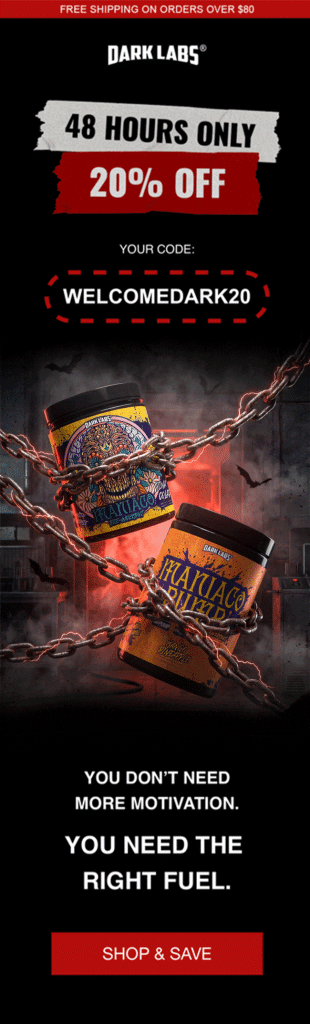
High-performing sports nutrition GIF use cases include:
- Flavor drops: looping reveals of the label, scoop pour, shaker mix, or flavor name animation
- Mixability proof: quick pour-and-shake loops showing smooth texture (huge for protein)
- Training ritual clips: short gym loops that feel like a brand anthem (perfect for pre-workout)
- Label transparency: a crisp loop highlighting clinical dosing or key ingredients
- Stack education: simple animated visuals showing how to combine pre + creatine + protein
Keep GIFs Clean, Premium, and Mobile-First
A GIF should feel like part of your design system — not a random meme dropped into an email. Best practices:
- keep file sizes lightweight so emails load fast
- design for mobile readability (most opens happen on mobile)
- use GIFs sparingly — 1–2 per email is typically enough
- pair motion with a clear CTA above the fold
- avoid overly flashy movement that distracts from conversion
In sports nutrition, the strongest campaigns feel like content — and the strongest content drives sales.
3) Stack + Bundle Campaigns (AOV + LTV Engines)
Stack campaigns are one of the highest-leverage email campaign types for sports nutrition brands because they increase AOV without increasing acquisition spend.
The strongest stack campaigns:
- anchor the routine (“training-day stack” / “daily base stack”)
- clarify what each product does
- make the bundle easy to buy
- segment messaging based on what the customer already owns
High-performing stack bundles include:
- Pre-workout + creatine + protein (complete muscle-building routine)
- Creatine + protein (daily consistency stack)
- Pump formula + creatine (performance without caffeine)
In sports nutrition, stack campaigns should feel like coaching — not upselling.
4) Drops + Flavor Launch Campaigns (Momentum Builders)
Sports nutrition is novelty-driven. Flavor launches and limited releases create spikes in revenue — especially for pre-workout and protein brands.
The best drop system runs in a sequence:
- 1. teaser (24–48 hours before)
- 2. early access (VIP/subscribers)
- 3. launch announcement
- 4. last chance / low inventory
- 5. post-launch proof (“first reactions,” reviews, UGC)
SMS shines here because it’s immediate and feels like a real alert — as long as you don’t overuse it.
5) Subscription + Consistency Campaigns (Predictable Revenue)
Subscription works when framed as consistency and control — not just savings.
These campaigns perform best when they feel supportive:
- “Never miss a day of creatine”
- “Lock in your training stack”
- “Subscribers get early access to drops + flavors”
- “Swap flavors anytime, skip whenever you need”
Subscription campaigns are one of the most profitable campaign types for sports nutrition brands because they convert a purchase into a habit.
6) Community + Culture Campaigns (Belonging Builders)
This is how sports nutrition brands create religious brand followers.
Culture campaigns include:
- UGC roundups (“stack check,” gym bag setups)
- athlete routines and “what I take” breakdowns
- customer stories framed safely and credibly
- founder POV notes
- training rituals (“Monday reset,” “leg day fuel,” “cut season stack”)
These campaigns increase engagement and protect retention — which is what keeps LTV strong even when CAC rises.
Campaign Angles by Product Type (Sports Nutrition-Specific Examples)
Sports nutrition brands win when campaign angles mirror how customers actually think.
Pre-Workout (Stim) Email Campaign Angles
- “High-stim vs balanced energy: choosing your training-day fuel”
- “How to avoid the crash (timing, dosage, routine)”
- “Beta alanine tingles: why they happen and how to dose”
- “Focus + energy without jitters: who this formula is for”
- “Your training-day ritual: what to take and when”
Stim-Free Pre-Workout + Pump Campaign Angles
- “Pump + focus without caffeine: when stim-free wins”
- “Second-session training stack (no crash, no sleep disruption)”
- “What actually drives a pump: citrulline, glycerol, nitrates”
- “Night training stack: pump + creatine + hydration”
Creatine Monohydrate Campaign Angles
- “Creatine daily habit: the simplest performance upgrade”
- “Loading vs no loading: what matters (and what doesn’t)”
- “Creatine myths: bloating, water retention, and reality”
- “What to expect in week 1 vs week 4”
- “Creatine monohydrate vs HCL: what’s actually different?”
Protein Powder (Whey + Casein) Campaign Angles
- “Whey isolate vs concentrate: which is right for digestion and macros?”
- “Taste + mixability proof: why customers keep reordering”
- “Recipe-based campaigns: smoothies, oats, protein ice cream”
- “Lean muscle support: protein as a daily consistency staple”
- “Casein before bed: nighttime recovery routine”
A 30-Day Email + SMS Campaign Calendar for Sports Nutrition Brands (Example)
If you want predictable performance, you need a rhythm.
Here’s a sample monthly cadence for a DTC sports nutrition brand selling pre-workout, creatine monohydrate, and protein powder.
Week 1 — Education + Trust
Email: Ingredient education (stim vs stim-free, creatine consistency, isolate vs concentrate)
SMS: optional quick “tip + link” if engagement is strong
Goal: build belief and improve conversion across upcoming sends
SMS: optional quick “tip + link” if engagement is strong
Goal: build belief and improve conversion across upcoming sends
Week 2 — Product Spotlight + Proof
Email: Hero product spotlight + reviews + label transparency
SMS: short reminder 6–12 hours later (“quick link if you missed it”)
Goal: drive revenue without discounting
SMS: short reminder 6–12 hours later (“quick link if you missed it”)
Goal: drive revenue without discounting
Week 3 — Stack Bundle + Routine
Email: “Complete your stack” bundle push with segmentation
SMS: deadline or inventory-based urgency if real
Goal: increase AOV and move customers into ecosystem buying
SMS: deadline or inventory-based urgency if real
Goal: increase AOV and move customers into ecosystem buying
Week 4 — Drop / Launch or Subscription Push
Email: flavor drop sequence or subscription consistency campaign
SMS: early access + last chance (if relevant)
Goal: spikes + subscription adoption + momentum
SMS: early access + last chance (if relevant)
Goal: spikes + subscription adoption + momentum
This calendar works because it balances selling with brand building — and it keeps customers engaged without spamming.
Segmentation: The Key to Sports Nutrition Email Marketing Performance
Campaign performance improves dramatically when segmentation reflects how people train and buy.
High-leverage segments for DTC sports nutrition brands include:
- stim vs stim-free pre-workout buyers
- pump formula shoppers
- creatine first-time vs repeat buyers
- protein buyers who prioritize taste vs macro purity
- stack buyers vs single SKU buyers
- subscribers vs one-time buyers
- high-LTV VIP customers
- lapsed customers (30/60/90-day windows)
Segmentation is how you increase revenue without turning every campaign into a discount.
SMS Best Practices for Sports Nutrition Brands (So You Don’t Burn Your List)
Sports nutrition SMS works best when it feels like:
- a drop alert
- a restock reminder
- a deadline nudge
- a training-day ritual moment
- a quick “don’t miss this” signal
SMS fails when brands treat it like email — long, frequent, and overly promotional.
Strong SMS programs typically follow these principles:
- keep sends limited and intentional
- segment heavily by product interest and buyer type
- use SMS only when there’s a clear action or urgency
- pair SMS with stronger email content (education + proof)
- avoid constant discounting that trains customers to wait
SMS should amplify your calendar — not replace it. Forge also ensures that the brands we work with are in complete compliance with SMS regulatory requirements. Some information on SMS compliance is available at Postscript.
The Biggest Campaign Mistakes Sports Nutrition Brands Make
Most brands don’t underperform because email “doesn’t work.” They underperform because their strategy is reactive and overly promotional.
Common mistakes include:
- sending only promotions and discounts
- inconsistent cadence (silence, then spam bursts)
- weak creative and limited proof (especially for taste/mixability)
- no segmentation by product type or training identity
- treating SMS as a second email channel
- failing to connect campaigns to automations, subscriptions, and retention strategy
Campaigns should feel like a system — not a slot machine.
Final Takeaway: Email + SMS Campaigns Build Momentum and Revenue
Email Automations stabilize revenue. Email + SMS campaigns scale it.
For sports nutrition brands, the best campaign calendars feel like part of the customer’s training routine: a consistent rhythm of education, proof, drops, stacks, and community.
That’s how brands increase LTV, reduce discount dependence, and build a customer base that buys again and again.
Next Step: Get Your Campaign Calendar + SMS Revenue Roadmap
If your campaigns feel inconsistent, overly promotional, or unpredictable, Forge can audit your last 30–60 days and build a sports nutrition-specific campaign calendar designed to:
- increase campaign revenue
- improve engagement and deliverability
- reduce discount dependence
- increase stack adoption and LTV
- accelerate subscription growth
Request a Campaign + SMS Audit and we’ll map the exact strategy your brand needs to drive predictable monthly revenue.