
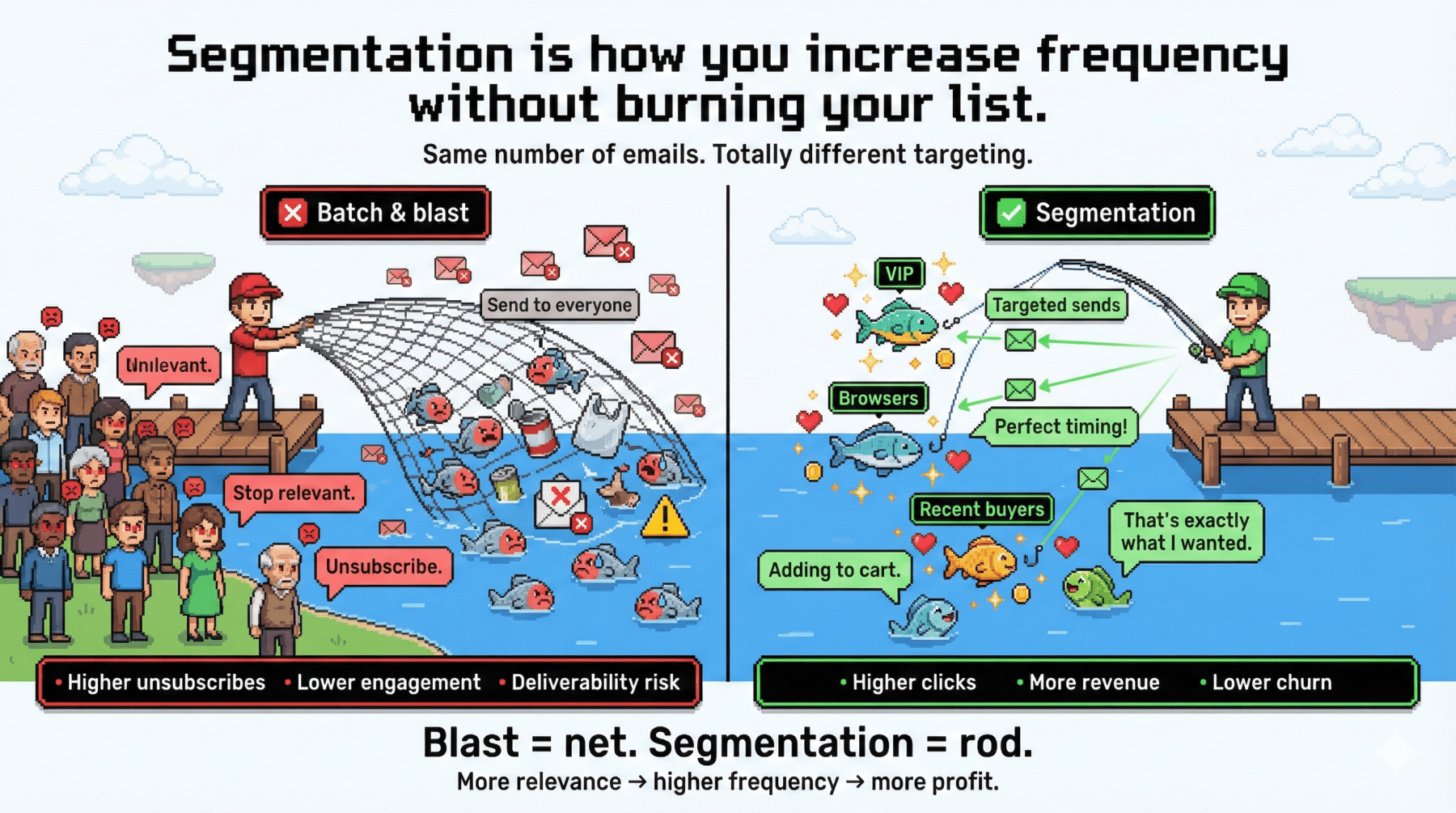
Most ecommerce brands have the same email problem.
They know email and SMS drive revenue.
They know they should be showing up more often.
They know their competitors are sending a lot.
But they hesitate.
Because deep down, they’re thinking:
“If we increase frequency, we’ll annoy people and get unsubscribes.”
And they’re not wrong — if you send the same message to everyone.
That’s the part most brands miss.
The real issue isn’t frequency. It’s relevance.
Email and SMS are high-frequency channels by design.
If someone opts into your list, they’re giving you permission to show up consistently — and if you do it right, they’ll want you to.
But here’s the catch:
You can’t send high-frequency campaigns to a broad list and expect it to work.
That’s how you end up with:
high unsubscribe rates
spam complaints
declining engagement
poor deliverability
and a list that becomes “dead weight”
The fix isn’t sending less.
The fix is segmentation.
Why segmentation matters more in 2026 than ever
In 2026, DTC brands aren’t competing on products alone.
They’re competing on:
speed of communication
personalization
relevance
experience
retention
The average customer is seeing hundreds of messages per day across ads, social, and inbox.
So if your emails feel generic, customers tune you out instantly.
Segmentation is how you avoid being “just another brand blasting promotions.”
It lets you send more while making it feel like less.
DTC brands with multiple SKUs can’t afford generic messaging
The more SKUs you have, the more dangerous it becomes to send the same message to everyone.
Because not everyone wants the same thing.
A customer who bought a:
hydration supplement
is not the same as someone who bought
sleep gummies
A customer shopping:
men’s denim
is not the same as someone browsing
plus-size dresses
When brands ignore this, they accidentally do two things:
They waste impressions on irrelevant content
They train customers to ignore their emails
That’s why hyper segmentation is the real unlock.
Let’s give our typical clientele some specific examples for health and wellness DTC brands looking to improve email list segmentation:
1) Segmentation ideas for a supplement brand with multiple SKUs
Supplement customers don’t buy “products.”
They buy outcomes.
That means segmentation should focus on:
goal-based journeys
replenishment cycles
stack behavior
compliance/education
A) Try segmenting by goal / desired outcome
This is the highest ROI segmentation for supplements.
Examples:
Sleep support buyers
Gut health buyers
Stress / cortisol buyers
Energy / focus buyers
Fitness performance buyers
Weight loss support buyers
Women’s hormone support buyers
How to build this type of segmentation:
Create segments for supplement brands by using your first and zero party data (stuff you know because a customer did it on your site or has explicitly or implicitly told you about themselves/their interests) like:
Purchase history (SKU tags)
Quiz results
Browse behavior (product page category)
Click behavior (emails clicked)
What to send to supplement brands’ email subscribers:
content tailored to their goal
bundles for that goal
testimonials from customers with the same goal
“3-step protocol” education series
B) Segment by replenishment window (refill timing)
This is how you scale frequency without unsubscribes.
Examples:
14–21 days post purchase (low supply warning)
25–35 days (refill reminder)
40–60 days (lapsed supplement customer)
What to send:
refill reminders
“your next bottle is due” SMS
subscribe & save push
reorder incentives
C) Segment by stack behavior
This one prints money.
Examples:
Bought 1 SKU only (needs cross-sell)
Bought 2+ SKUs (stackers / higher LTV)
Bought a bundle (bundle buyers)
Bought only powders vs only capsules
What to send:
“complete the stack” cross-sells
routines: morning vs night stack
upsell to bundle
VIP access / loyalty offers
D) Segment by product sophistication
Supplements are confusing. Your list isn’t equally educated.
Examples:
New supplement customers (need education)
Advanced buyers (want ingredients, dosage, science)
Subscription members (already trust you)
What to send:
ingredient explainers
compliance/consistency tips
FAQ + objections (safety, effectiveness, taste)
E) Segment by objection type
This is huge for retargeting and email.
Examples:
“Does it work?” skeptics
“Too expensive” customers
“I don’t trust supplements” customers
“I forget to take them” customers
What to send:
social proof and reviews
before/after stories
UGC testimonials
cost-per-day breakdown
2) Segmentation ideas for a skincare brand with multiple SKUs
Skincare is personal.
People buy based on:
skin type
skin concern
routine stage
seasonality
This means segmentation should feel like:
“This brand is basically my esthetician.”
A) Segment by skin concern
This is the equivalent of “goal segmentation” in supplements.
Examples:
Acne / breakouts
Anti-aging / fine lines
Hyperpigmentation / dark spots
Dryness / dehydration
Redness / rosacea / sensitivity
Texture / pores
How to build it:
quiz results
product page views
purchases (concern tags per SKU)
What to send:
concern-specific routines
before/after content
ingredient education (“why niacinamide works for ___”)
UGC by concern type
B) Segment by skin type
Skin type changes what products are “safe” and “relevant.”
Examples:
Oily
Dry
Combination
Sensitive
What to send:
routines by skin type
“avoid these ingredients if you’re sensitive”
personalized product recommendations
C) Segment by routine stage
This one is incredibly profitable because it naturally drives upsells.
Examples:
Cleanser-only buyers
Serum buyers
Moisturizer-only buyers
Full routine buyers (high LTV)
Sunscreen buyers (seasonal + daily use)
What to send:
“next step in your routine” education
“complete the routine” bundle offers
how-to content: order of application
D) Segment by ingredient affinity
This is advanced, but it’s elite for skincare.
Examples:
Retinol users
Vitamin C users
Niacinamide users
Peptide lovers
Barrier repair customers
What to send:
ingredient education
new product launches for that ingredient
“how to layer” guides
caution/contraindication tips
E) Segment by seasonality + climate
Skincare is affected by environment.
Examples:
Winter dryness segment
Summer SPF + oil control segment
Humid climate vs dry climate
“travel kit” segment
What to send:
seasonal routines
weather-based product pushes
SPF reminders via SMS
Quick cheat codes: segmentation that works for BOTH categories
If you want 80/20 segments that apply to any multi-SKU DTC brand:
VIP / high LTV (top 10–20%)
First-time buyers (need trust + second purchase push)
Browsers (viewed category, no purchase)
Cart abandoners (high intent)
Lapsed customers (winback angle)
Discount-only shoppers (price objection)
New subscribers (education + brand story)
What hyper segmentation actually means (and why it prints money)
Hyper segmentation isn’t complicated.
It just means you stop treating your list like one audience.
Instead, you build mini audiences based on:
what they’ve purchased
what they’ve viewed
what they’ve clicked
what they’re interested in
where they are in the customer journey
Then you send messages that match that context.
Example:
Instead of sending one campaign:
“20% off everything!”
You send:
“Back in stock: the denim you viewed” (Browse segment)
“Complete the set” (Recent purchasers)
“VIP early access” (High LTV)
“Need help choosing your fit?” (High return-risk shoppers)
“Refill reminder” (Consumables)
Same send day. Same offer window.
Totally different relevance.
That’s how you scale frequency without damaging your list.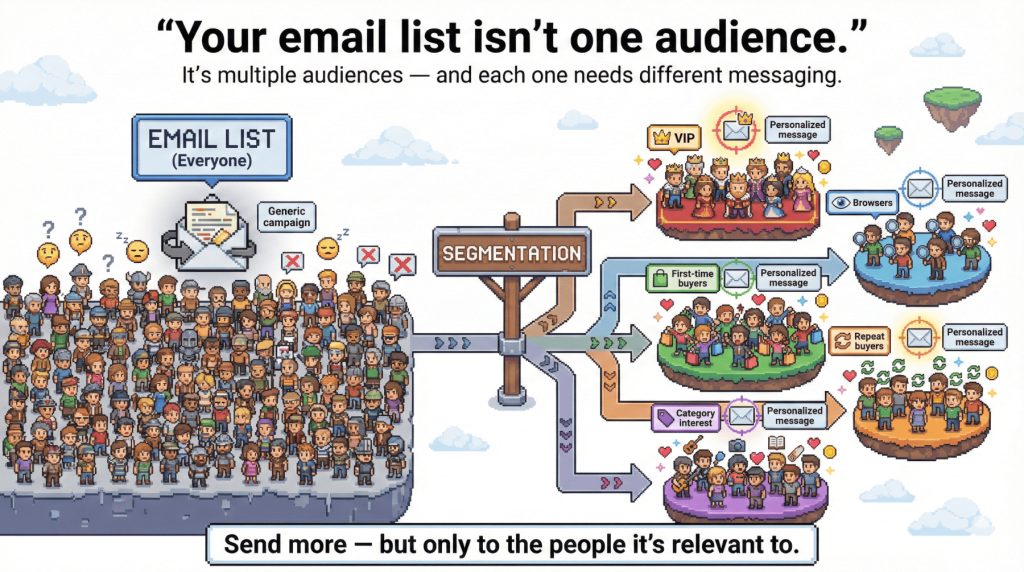
Frequency is the growth lever. Segmentation is the safety mechanism.
Here’s the truth:
If you want email + SMS to become a major revenue channel, you need to increase touchpoints.
But if you increase touchpoints without segmentation, you’ll create churn.
Segmentation is what makes your customer feel like:
“This brand gets me.”
And that’s what converts.
The Forge approach: send more — but to fewer people at a time
At Forge, we don’t increase frequency by blasting your entire list more often.
We increase frequency by building a segmentation engine that lets you send:
more campaigns
more automations
more personalized content
…without overwhelming any one customer.
So instead of sending 5 emails per week to everyone…
You might send:
5 emails per week total
but each person only receives 1–2
and every message feels relevant
That’s how top DTC brands win.
Bottom line
If your list is segmented correctly, you can send more — and customers will thank you for it.
Because the real goal isn’t to “send emails.”
It’s to deliver the right message, to the right customer, at the right time.
And segmentation is the system that makes that scalable.