Your address will show here +12 34 56 78
eCommerce, Email Marketing, Supplement Marketing

Most ecommerce brands have the same email problem.

They know email and SMS drive revenue.
They know they should be showing up more often.
They know their competitors are sending a lot.

But they hesitate.

Because deep down, they’re thinking:

“If we increase frequency, we’ll annoy people and get unsubscribes.”

And they’re not wrong — if you send the same message to everyone.

That’s the part most brands miss.

The real issue isn’t frequency. It’s relevance.

Email and SMS are high-frequency channels by design.

If someone opts into your list, they’re giving you permission to show up consistently — and if you do it right, they’ll want you to.

But here’s the catch:

You can’t send high-frequency campaigns to a broad list and expect it to work.

That’s how you end up with:

  • high unsubscribe rates

  • spam complaints

  • declining engagement

  • poor deliverability

  • and a list that becomes “dead weight”

The fix isn’t sending less.

The fix is segmentation.

Why segmentation matters more in 2026 than ever

In 2026, DTC brands aren’t competing on products alone.

They’re competing on:

  • speed of communication

  • personalization

  • relevance

  • experience

  • retention

The average customer is seeing hundreds of messages per day across ads, social, and inbox.

So if your emails feel generic, customers tune you out instantly.

Segmentation is how you avoid being “just another brand blasting promotions.”

It lets you send more while making it feel like less.

DTC brands with multiple SKUs can’t afford generic messaging

The more SKUs you have, the more dangerous it becomes to send the same message to everyone.

Because not everyone wants the same thing.

A customer who bought a:
hydration supplement
is not the same as someone who bought
sleep gummies

A customer shopping:

men’s denim
is not the same as someone browsing
plus-size dresses


When brands ignore this, they accidentally do two things:

  1. They waste impressions on irrelevant content

  2. They train customers to ignore their emails

That’s why hyper segmentation is the real unlock.

Let’s give our typical clientele some specific examples for health and wellness DTC brands looking to improve email list segmentation:

1) Segmentation ideas for a supplement brand with multiple SKUs

Supplement customers don’t buy “products.”
They buy outcomes.

That means segmentation should focus on:

  • goal-based journeys

  • replenishment cycles

  • stack behavior

  • compliance/education

A) Try segmenting by goal / desired outcome

This is the highest ROI segmentation for supplements.

Examples:

  • Sleep support buyers

  • Gut health buyers

  • Stress / cortisol buyers

  • Energy / focus buyers

  • Fitness performance buyers

  • Weight loss support buyers

  • Women’s hormone support buyers

How to build this type of segmentation:
Create segments for supplement brands by using your first and zero party data (stuff you know because a customer did it on your site or has explicitly or implicitly told you about themselves/their interests) like:

  • Purchase history (SKU tags)

  • Quiz results

  • Browse behavior (product page category)

  • Click behavior (emails clicked)

What to send to supplement brands’ email subscribers:

  • content tailored to their goal

  • bundles for that goal

  • testimonials from customers with the same goal

  • “3-step protocol” education series

B) Segment by replenishment window (refill timing)

This is how you scale frequency without unsubscribes.

Examples:

  • 14–21 days post purchase (low supply warning)

  • 25–35 days (refill reminder)

  • 40–60 days (lapsed supplement customer)

What to send:

  • refill reminders

  • “your next bottle is due” SMS

  • subscribe & save push

  • reorder incentives

C) Segment by stack behavior

This one prints money.

Examples:

  • Bought 1 SKU only (needs cross-sell)

  • Bought 2+ SKUs (stackers / higher LTV)

  • Bought a bundle (bundle buyers)

  • Bought only powders vs only capsules

What to send:

  • “complete the stack” cross-sells

  • routines: morning vs night stack

  • upsell to bundle

  • VIP access / loyalty offers

D) Segment by product sophistication

Supplements are confusing. Your list isn’t equally educated.

Examples:

  • New supplement customers (need education)

  • Advanced buyers (want ingredients, dosage, science)

  • Subscription members (already trust you)

What to send:

  • ingredient explainers

  • compliance/consistency tips

  • FAQ + objections (safety, effectiveness, taste)

E) Segment by objection type

This is huge for retargeting and email.

Examples:

  • “Does it work?” skeptics

  • “Too expensive” customers

  • “I don’t trust supplements” customers

  • “I forget to take them” customers

What to send:

  • social proof and reviews

  • before/after stories

  • UGC testimonials

  • cost-per-day breakdown

2) Segmentation ideas for a skincare brand with multiple SKUs

Skincare is personal.
People buy based on:

  • skin type

  • skin concern

  • routine stage

  • seasonality

This means segmentation should feel like:

“This brand is basically my esthetician.”

A) Segment by skin concern

This is the equivalent of “goal segmentation” in supplements.

Examples:

  • Acne / breakouts

  • Anti-aging / fine lines

  • Hyperpigmentation / dark spots

  • Dryness / dehydration

  • Redness / rosacea / sensitivity

  • Texture / pores

How to build it:

  • quiz results

  • product page views

  • purchases (concern tags per SKU)

What to send:

  • concern-specific routines

  • before/after content

  • ingredient education (“why niacinamide works for ___”)

  • UGC by concern type

B) Segment by skin type

Skin type changes what products are “safe” and “relevant.”

Examples:

  • Oily

  • Dry

  • Combination

  • Sensitive

What to send:

  • routines by skin type

  • “avoid these ingredients if you’re sensitive”

  • personalized product recommendations

C) Segment by routine stage

This one is incredibly profitable because it naturally drives upsells.

Examples:

  • Cleanser-only buyers

  • Serum buyers

  • Moisturizer-only buyers

  • Full routine buyers (high LTV)

  • Sunscreen buyers (seasonal + daily use)

What to send:

  • “next step in your routine” education

  • “complete the routine” bundle offers

  • how-to content: order of application

D) Segment by ingredient affinity

This is advanced, but it’s elite for skincare.

Examples:

  • Retinol users

  • Vitamin C users

  • Niacinamide users

  • Peptide lovers

  • Barrier repair customers

What to send:

  • ingredient education

  • new product launches for that ingredient

  • “how to layer” guides

  • caution/contraindication tips

E) Segment by seasonality + climate

Skincare is affected by environment.

Examples:

  • Winter dryness segment

  • Summer SPF + oil control segment

  • Humid climate vs dry climate

  • “travel kit” segment

What to send:

  • seasonal routines

  • weather-based product pushes

  • SPF reminders via SMS

Quick cheat codes: segmentation that works for BOTH categories

If you want 80/20 segments that apply to any multi-SKU DTC brand:

  • VIP / high LTV (top 10–20%)

  • First-time buyers (need trust + second purchase push)

  • Browsers (viewed category, no purchase)

  • Cart abandoners (high intent)

  • Lapsed customers (winback angle)

  • Discount-only shoppers (price objection)

  • New subscribers (education + brand story)

What hyper segmentation actually means (and why it prints money)

Hyper segmentation isn’t complicated.

It just means you stop treating your list like one audience.

Instead, you build mini audiences based on:

  • what they’ve purchased

  • what they’ve viewed

  • what they’ve clicked

  • what they’re interested in

  • where they are in the customer journey

Then you send messages that match that context.

Example:

Instead of sending one campaign:

“20% off everything!”

You send:

  • “Back in stock: the denim you viewed” (Browse segment)

  • “Complete the set” (Recent purchasers)

  • “VIP early access” (High LTV)

  • “Need help choosing your fit?” (High return-risk shoppers)

  • “Refill reminder” (Consumables)

Same send day. Same offer window.
Totally different relevance.

That’s how you scale frequency without damaging your list.
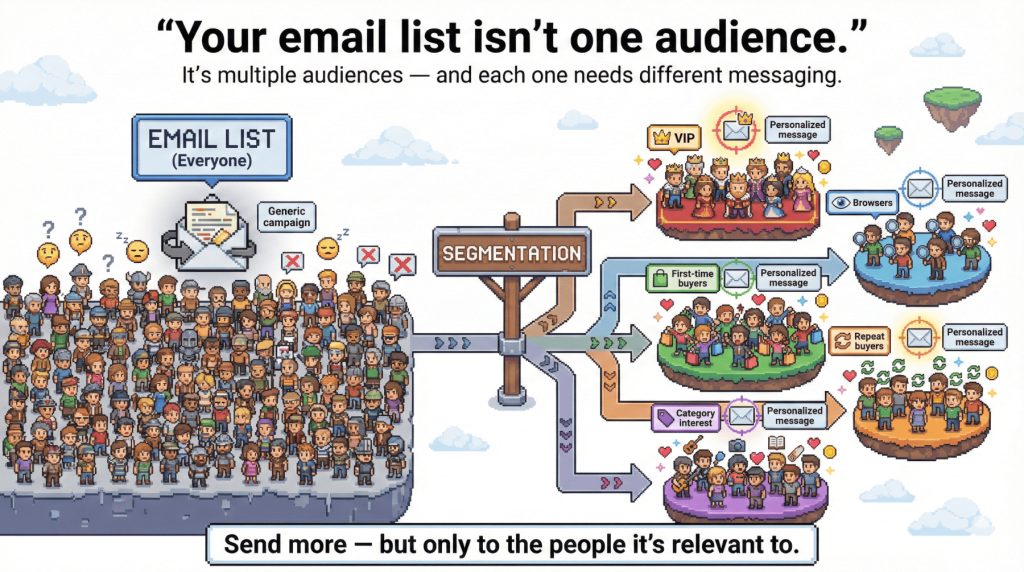
Frequency is the growth lever. Segmentation is the safety mechanism.

Here’s the truth:

If you want email + SMS to become a major revenue channel, you need to increase touchpoints.

But if you increase touchpoints without segmentation, you’ll create churn.

Segmentation is what makes your customer feel like:

“This brand gets me.”

And that’s what converts.

The Forge approach: send more — but to fewer people at a time

At Forge, we don’t increase frequency by blasting your entire list more often.

We increase frequency by building a segmentation engine that lets you send:

  • more campaigns

  • more automations

  • more personalized content

…without overwhelming any one customer.

So instead of sending 5 emails per week to everyone…

You might send:

  • 5 emails per week total

  • but each person only receives 1–2

  • and every message feels relevant

That’s how top DTC brands win.

Bottom line

If your list is segmented correctly, you can send more — and customers will thank you for it.

Because the real goal isn’t to “send emails.”

It’s to deliver the right message, to the right customer, at the right time.

And segmentation is the system that makes that scalable.

0

SEO, Supplement Marketing

If you’re looking to sell kratom online in 2025, you’re in the right place. The landscape for marketing botanicals like kratom is evolving—fast. In this guide, we’ll share cutting-edge digital marketing strategies including programmatic advertising, SEO, email marketing, and compliant commerce tools that can help you grow your kratom business sustainably.

Programmatic Display Advertising

Programmatic display advertising is a great way to get your kratom products in front of the right people. With programmatic advertising, you can use data to target specific audiences based on demographics, interests, and browsing behavior. This means you can reach potential customers who are already interested in kratom, and you can do it in a cost-effective way.

To get started with programmatic advertising, you’ll need to partner with a reputable ad network or demand-side platform (DSP). Look for a platform that offers real-time bidding, advanced targeting options, and reporting and analytics tools. Then, create eye-catching ads that showcase your products and highlight their benefits. Finally, set your campaign budget and launch your ads.

Programmatic advertising remains one of the fastest ways to scale visibility for kratom brands—if done correctly.

What’s New in 2025:

  • AI-powered audience segmentation: Platforms now leverage machine learning to micro-target audiences who’ve shown kratom interest signals across forums, Reddit, and alternative wellness sites.

  • Geofencing for legal compliance: Use location-based targeting to avoid showing ads in restricted states.

  • Cookieless solutions: With third-party cookies phasing out, ensure your DSP uses first-party data strategies.

Action Steps:

  1. Partner with DSPs that support high-risk or regulated categories.

  2. Use interactive formats like video carousels or animated banners.

  3. A/B test your creatives for engagement and CTR, not just impressions.

Search Engine Optimization

Search engine optimization (SEO) is the practice of optimizing your website and content to rank higher in search engine results pages (SERPs). By optimizing your site for relevant keywords, you can attract more organic traffic and generate more leads and sales.

SEO is still the cornerstone of sustainable growth for kratom businesses. However, the kratom niche is ultra-competitive and Google’s algorithms continue to scrutinize YMYL (Your Money, Your Life) topics—like herbal supplements.

For a real-world example, see how we turned an SEO disaster into digital dominance in our CBD & Kratom SEO case study.

2025 SEO Priorities:

  • E-E-A-T: Emphasize Experience, Expertise, Authoritativeness, and Trust. Include author bios, cite medical sources, and include transparent disclaimers.

  • Topical authority: Build clusters of content around kratom benefits, legality by state, usage guides, strain comparisons, and buyer safety.

  • Video SEO: Embed short, informative videos with transcript-rich schema.

  • Speed + UX: Google’s Core Web Vitals are a stronger ranking factor than ever.

Keyword Tip: Include long-tail terms like “best kratom for focus 2025” or “is kratom legal in [state]” and monitor SERP features like People Also Ask boxes.

Warning: Avoid black-hat or outdated link-building tactics. Demand real case studies from any SEO agency you hire.

To optimize your site for kratom-related keywords, start by conducting keyword research to identify the terms that people are searching for. Then, create high-quality content that targets these keywords, and optimize your site’s on-page elements, such as title tags, meta descriptions, and headers. Don’t forget your image alt text! Finally, build high-quality backlinks to your site from other reputable websites in your industry.

This is a highly competitive niche to compete in for SEO. Beware of cheap SEO agencies who promise the world and do not have evidence of delivering previously. Always ask your SEO partner for case studies that showcase their kratom SEO prowess!

Email Marketing & SMS Marketing for Kratom Sellers

Email marketing is a powerful way to build relationships with your customers and keep them engaged with your brand. With email marketing, you can send targeted messages to your subscribers based on their interests, behaviors, and buying habits. You can also use email to promote new products, offer exclusive discounts, and provide helpful content.

Email marketing continues to deliver exceptional ROI—but with more restrictions on kratom in mainstream platforms, your tech stack matters.

To get started with email marketing, you’ll need to build an email list of subscribers who have opted in to receive your messages. Then, use a reputable email marketing platform (ESP) to design and send your messages. Make sure your emails are visually appealing, mobile-friendly, and personalized to each recipient. Finally, track your results and adjust your strategy based on what’s working and what’s not.

We recommend utilizing Klaviyo as your email marketing platform if you’re a kratom seller. You’re going to be hardpressed to find another email provider with robust integrations for Woocommerce, Shopify and Bigcommerce and other CRMs that ALSO has kratom whitelisted (or allowed) on its platform. However, you will find SMS or text message marketing a challenge.

Why Klaviyo Still Rules in 2025:

  • Still kratom-friendly.

  • Deep integration with WooCommerce, Shopify, and BigCommerce.

  • Supports dynamic segments, automations, and advanced reporting.

Tactics:

  • Offer opt-in incentives (10% off, free shipping).

  • Build flows: Welcome, Abandon Cart, Post-Purchase, Replenishment.

  • Use surveys to personalize product suggestions (e.g., pain relief vs. energy).

SMS Marketing

Due to ongoing challenges with SMS carriers and kratom-related restrictions, you’ll need niche-compliant partners. Forge has one trusted provider that still allows compliant SMS delivery in 2025.

Compliant Checkout & Merchant Solutions

Selling kratom online requires specialized payment processing and platforms. Most mainstream providers like Stripe, Square, and PayPal still ban kratom.

Solutions in 2025:

  • High-risk merchant accounts via specialized processors.

  • WooCommerce and BigCommerce integrations with payment gateways like Easy Pay Direct or DigiPay.

  • Ensure your checkout pages clearly display legal disclaimers and terms of service.

Pro Tip: Work with developers who understand kratom compliance to avoid failed audits or shutdowns.

Bulk Kratom from EZ Kratom

If you’re looking for a reliable bulk kratom supplier to start your brand with, look no further than EZ KRATOM. This trusted supplier offers high-quality kratom at competitive prices, and they ship quickly and discreetly. Plus, they offer a wide variety of strains and formats, including powder, capsules, and extracts.

eCommerce Platforms for Kratom Sellers in 2025: Shopify is Now a Viable Option

Historically, Shopify had strict limitations against selling kratom and other botanicals. But as of 2024 and moving into 2025, Shopify has become a more flexible and viable platform for kratom, kava, alt-wellness, and even some hemp-derived THC product sellers.

Why Shopify Works Now

Many of our clients in the botanical space are now operating successful Shopify and Shopify Plus stores. Shopify’s policy updates, combined with the ability to use approved third-party payment gateways, have opened the door to kratom businesses that prioritize compliance and transparency.

Benefits of Shopify for Kratom Sellers:

  • Fast, scalable storefronts with built-in hosting and security

  • Robust app ecosystem for loyalty, upsells, email, and reviews

  • Shopify Plus options for high-volume kratom brands

  • Support for high-risk payment processors like DigiPay and Easy Pay Direct (via approved integrations)

  • Seamless plug-ins for Klaviyo (email) and Gorgias (support)

⚠️ Note: You still need to use a compliant payment gateway. Shopify Payments (powered by Stripe) does not allow kratom. You must use a vetted high-risk merchant provider with Shopify integration.


Pro Tip:

When building your kratom store on Shopify, include a Terms of Use and Legal Disclaimer page to meet compliance requirements and reduce merchant risk. Forge can assist with both your eCommerce setup and compliant checkout integrations.

In conclusion, selling kratom online can be a profitable and rewarding business. By using programmatic display advertising, search engine optimization, and email marketing, you can reach more customers and grow your business. And with a reliable supplier like Ez Kratom you can rest assured that you’re offering your customers the best possible products.

0

eCommerce, Marketing, Supplement Marketing

The world is more focused on health and wellness than ever before. As of 2021, more than 57% of US adults took a health supplement in the past month. 

Marketing wellness products is all about figuring out who your target audience is and deciding the best way to reach them. It may be tempting to just put your health supplements out there and hope they gain traction, but having a marketing plan is a much better way to reach success. 

We’ve put together a guide full of ten tips for how to best market your wellness supplements so you can reach as wide of an audience as possible. 

1. Follow FDA Guidelines

The FDA has rules that need to be followed if you’re putting health supplements out on the market. Make sure you’re up to date on what you can and can’t say (for example, making it clear that your supplements aren’t meant to treat, prevent, diagnose, or cure diseases).

This will ensure everyone stays safe and your business stays thriving!

2. Put Time into Social Media Marketing, Google Ads, and Email Marketing

Much of the marketing content people see these days is online. To promote your wellness supplements most effectively, you’ll want to ensure you’re on social media. 

Create at least one or two accounts on platforms like Instagram, Facebook, Twitter, or TikTok and begin posting regularly. An online presence is crucial to success, so don’t brush social media aside, even if marketing on it is new to you. 

Don’t shy away from paid advertising on Google and also invest 

3. Prioritize Packaging and Labeling

When potential customers are wandering the aisles of stores, a visually appealing product is what catches their attention. And this all starts with putting extra thought into the packaging. 

When designing your label and packaging, choose colors and visuals that cause a second glance and are easy to read. You want buyers to know exactly what the product is after a quick look, but colorful or unique packaging can make them stick around to read the back, too.  

4. Create an Accessible Website

Your website should contain all of the information people might be looking for about your business or brand. This includes things like the ingredients of your supplements and detailed product descriptions, usage instructions, ways of purchasing the products, and contact information.

Also, make sure your website is easy to read and navigate on phones and is ADA compliant so it’s accessible to as many people as possible. 

5. Use Positive Reviews to Your Advantage

Speaking of websites, positive reviews and testimonials are great things to add to your website to make it really shine. 

People would rather listen to real buyers’ opinions on wellness supplements than the businesses’s, as these are seen as unbiased and authentic. Displaying positive reviews and comments on your website and social media pages is a powerful way of building trust among consumers and boosting sales. 

6. Emphasize Your Brand’s Uniqueness

While you may not like to think about it, there are many other health supplements out there. If you want people to choose yours own your competition, you need to show them why you’re the better pick. 

Think about what makes your brand different from all the others, whether it’s your special ingredients, bold aesthetic, or community outreach. Make an effort to tell consumers all about your business’s unique qualities so they remember you as the best choice. 

7. Offer Valuable Content

It isn’t enough to just post photos of your supplements with the caption, “Try these out today!” on social media pages. You need to capture people’s attention and make them glad they’re following your business. 

You can do this by giving people valuable information that they’ve been looking for (or better yet, they didn’t even know they needed!). There are tons of ways of providing informative content, like live streams Q&As, long-form blog articles, interviews with health and wellness professionals, or how-to videos with delicious recipes. 

The more engaging and informative content you create, the more people will trust your brand to provide them with the best health tips possible – including taking your wellness supplements. 

8. Give Away Samples and Discounts

When it comes to marketing supplements, one of the easiest ways is to offer people a sample of the real thing.

You can do this both in person by giving someone a couple supplements to try, Costco-sample style, or you can offer samples of new supplements that come with people’s purchases. 

It’s also a good idea to give out discounts to encourage people to purchase more supplements, whether the discounts are for new buyers, repeat buyers, or bulk orders. 

9. Highlight a Healthy Formula

If someone is purchasing supplements, it’s likely that they’re fairly health-focused. They care about putting the highest-quality ingredients in their bodies, and they expect you to care about this too. 

If your wellness supplements feature special health characteristics, such as being vegan, kosher, gluten-free, organic, or plant-based, make sure this information is super visible to attract people’s attention. For instance, if your supplements are sustainably sourced, this phrase should be not only in the website description but also highlighted on the packaging and labels as well. 

10. Collaborate with Other Health Industry Pros

Reach out to other health professionals that may be interested in carrying or promoting your wellness supplements. This could include spas, gyms, doctors’ offices, or even health and wellness influencers. 

With the right collaboration, not only can you potentially sell more, but you can get your product in front of a whole new audience while fostering a powerful professional relationship with your collaborator. 

A Guide to Marketing Wellness Supplements Successfully 

Great wellness supplements can make a positive difference in people’s lives. If you want your supplements to be seen and tried by as many people as possible, you’ll want to focus on building a dynamic marketing strategy. 

If you’re looking for help with your online marketing, contact Forge Digital Marketing today. Our professional and experienced team can lead you and your business to success. 

0

Skip to content