Your address will show here +12 34 56 78
eCommerce, Email Marketing
Sports nutrition is one of the most repeat-purchase-friendly categories in ecommerce — but most brands still treat lifecycle marketing like an afterthought. They build a few generic flows, blast a weekly promotion, and hope customers reorder on their own.
That doesn’t scale in 2026.
Pre-workout is a training-day ritual. Creatine monohydrate is a daily habit. Protein powder is a routine staple. Customers don’t just buy these products — they build them into their identity, their gym bag, and their week. Email Automations are how sports nutrition brands reinforce that routine, drive second orders, and increase lifetime value without relying on discounts or constant paid acquisition.
Email Automations are also consistently one of the highest ROI growth systems available in ecommerce, often cited as producing 36x to 55x ROI when implemented correctly — because they convert existing demand more efficiently than any acquisition channel. In sports nutrition, that ROI compounds even faster because repeat purchase is built into the category.
This guide breaks down Forge’s Email Automation framework for sports nutrition brands selling stim and stim-free pre-workout, pump formulas, creatine monohydrate, whey isolate, concentrate, casein, and complete stack bundles.
TL;DR: The Email Automations That Matter Most
Forge’s Essential 5 Email Automations (Non-Negotiable)
Important Flows (Second Layer That Compounds LTV)
supplement email marketing

Why Email Automations Are a Profit Engine in Sports Nutrition

Email Automations drive revenue every day, automatically by capturing and converting the attention your paid media generates.
They work in sports nutrition because they reduce friction in the exact moments where customers hesitate:
Strong Email Automations answer these questions in a way that builds trust, reinforces routine, and guides customers toward repeat purchase and stack expansion. For sports nutrition brands, email automations also reinforce something very pivotal: cultural fit and belonging to a bigger, aspirational community.

Essential Flows: Forge’s 5 Email Automations Every Sports Nutrition Brand Needs

These five Email Automations build the backbone of your lifecycle revenue system — converting subscribers into buyers, buyers into repeat customers, and repeat customers into stack customers.

1) Welcome Series: Turn Subscribers into Buyers (and Buyers into Stack Customers)

A welcome series in sports nutrition isn’t just a discount email. It’s the first moment where you turn interest into confidence — and confidence into conversion.
The highest-performing welcome flows for pre-workout, creatine, and protein brands typically include:
A strong brand POV and identity signal
Sports nutrition customers choose brands that match their training identity. A hardcore bodybuilding pre-workout brand should feel different than a clean, minimalist creatine brand. Your welcome flow should make it immediately clear: who this brand is for, what it stands for, and why it exists.
A product fit pathway
Instead of forcing everyone into one product page, guide them to the right starting point:
Stack guidance
Sports nutrition customers think in stacks — not SKUs. A powerful welcome series introduces a simple “starter stack” framework:
This is where you teach the buyer to build their routine inside your ecosystem.

2) Browse Abandonment: Convert Comparison Shopping into Confidence

Browse abandonment is where sports nutrition brands win the skeptical buyer — the one who’s comparing three pre-workouts, two creatine brands, and five proteins on price.
This flow should do more than remind them. It should remove friction.
For sports nutrition, the strongest browse emails usually include:
Each persona has different objections, content preferences, and stacking behavior. When personas are correct, creative resonates instantly and conversion rates rise.
Examples of browse objections by product type:
Pre-workout (stim):
Pre-workout (stim-free) + pump formulas:
Creatine monohydrate:
Protein (whey isolate/concentrate/casein):
Browse abandonment should feel like a coach helping the buyer make a decision — not a brand begging for a purchase.

3) Cart Abandonment: Remove Risk and Make Checkout Easy

Most cart abandonment sequences in sports nutrition are too aggressive and too discount-dependent. The true goal of this flow is to remove risk and reinforce trust, bringing the interested customer back into the brand’s fold by overcoming known sales objections.
Cart abandonment should strengthen the reasons to buy:
This is also the best place to reinforce taste and mixability for protein and flavored pre-workouts. If taste confidence is weak, conversion drops.

4) Post-Purchase Onboarding: Build Routine, Reduce Churn, Drive Second Orders

Most sports nutrition brands don’t lose customers because the product is bad — they lose customers because the customer didn’t build the habit.
Post-purchase is where you turn the product into a routine.
A strong post-purchase onboarding sequence includes:
How to use it (timing + dosage)
What to expect (without overclaiming)
How to stack it
This is where second purchases are engineered.
Post-purchase onboarding is one of the highest-leverage flows in sports nutrition because it improves satisfaction, increases reorder likelihood, and sets up LTV.

5) Win-Back / Lapsed Buyer Flow: Reactivate Customers Before They Disappear

Sports nutrition customers don’t always “churn” with a complaint. They lapse quietly. They forget. They run out and switch brands. They stop training consistently. Then they don’t reorder.
Win-back automations bring them back into your ecosystem — and they work best when they feel aligned with the product the customer actually bought.
Win-back examples by category:
A good win-back flow feels like a re-entry into routine — not a generic discount blast.

Important Flows: The Second Layer That Compounds LTV

Once the Essential 5 are live and working, these flows compound lifetime value and strengthen retention through cadence, subscriptions, stack expansion, and advocacy.
Replenishment / Reorder Flow: Make Repeat Purchase Predictable
Sports nutrition replenishment should be built on servings, routine, and product type.
Reorder timing should adapt based on:
The most effective replenishment flows:

Subscription Onboarding + Churn Prevention Flow

Subscription works in sports nutrition when it’s framed as consistency, not just savings.
Subscription onboarding should:
When CRO is done correctly, paid media becomes cheaper because traffic converts more efficiently.

Cross-Sell / Stack Builder Flow: Turn Single-SKU Buyers into Ecosystem Customers

Stack customers are more profitable. Your email system should deliberately move customers into a complete routine.
Cross-sell examples:
The best stack builder flows feel like coaching — not upselling.

Review + UGC Request Flow: Build the Trust Flywheel

Sports nutrition buyers rely on proof. Reviews and UGC increase conversion, improve paid performance, and strengthen credibility across every channel.
Your review flow should:

VIP / Loyalty / High-LTV Flow

This is where you reward your best customers and deepen belonging:
Sports nutrition customers love feeling like insiders.

Back-in-Stock / Flavor Drop / Limited Launch Flow

If your brand runs flavor launches, limited releases, or restocks, these flows can generate massive spikes in revenue — especially for pre-workout and protein brands.
The key is to build drop communication like a brand moment:
This creates demand without discounting.

Common Mistakes Sports Nutrition Brands Make with Email Automations

Most automation systems underperform because they’re generic.
At Forge, SEO isn’t treated as a “blog strategy.” It’s treated as an authority engine designed to win discovery across Google and emerging AI-powered search experiences.
Automation is not about sending more emails.
It’s about sending the right message at the right moment — in the language sports nutrition customers actually care about.

Final Takeaway: Email Automations Are the Highest ROI System You Can Build

Email Automations are consistently one of the highest ROI investments an ecommerce brand can make — often cited as producing 36x to 55x ROI — because they convert demand you’ve already earned more efficiently than any acquisition channel.
For sports nutrition brands selling pre-workout, creatine monohydrate, and protein, Email Automations don’t just drive revenue. They reinforce routine, build belief, guide stacking behavior, and increase repeat purchase without constant discounting.
That’s how brands scale profitably in 2026.

Next Step: Get Your Lifecycle Automation Roadmap

If you want to identify how much revenue you’re leaving on the table, Forge can map your current Email Automations, highlight gaps, and deliver a sports nutrition-specific lifecycle roadmap designed to increase conversion, LTV, and repeat purchase.
Request an Email Marketing Audit and we’ll show you exactly where your next wave of email revenue should come from.

Up Next: Email Campaign Strategy for Sports Nutrition Brands

Once Email Automations are built, campaigns become your next growth engine — highlighting launches, selling in bundles, increasing subscription adoption, and generating additional predictable monthly revenue. Next, we’ll break down how sports nutrition brands should structure campaign calendars that consistently perform in sports nutrition.
0
eCommerce, Email Marketing
TL;DR
Forge’s Go-To-Market Playbook for Sports Nutrition Brands is a proven, compliance-aware growth system built to help pre-workout (stim + stim-free), pump formulas, creatine monohydrate, and protein brands (whey isolate, concentrate, and casein) launch, scale, and sustain profitable DTC growth.
In a category facing rising Meta and TikTok costs, stricter ad platform enforcement, consumer skepticism, and aggressive competition, success requires more than great formulations. It demands a system that integrates brand identity, creative velocity, conversion architecture, and retention economics from day one.

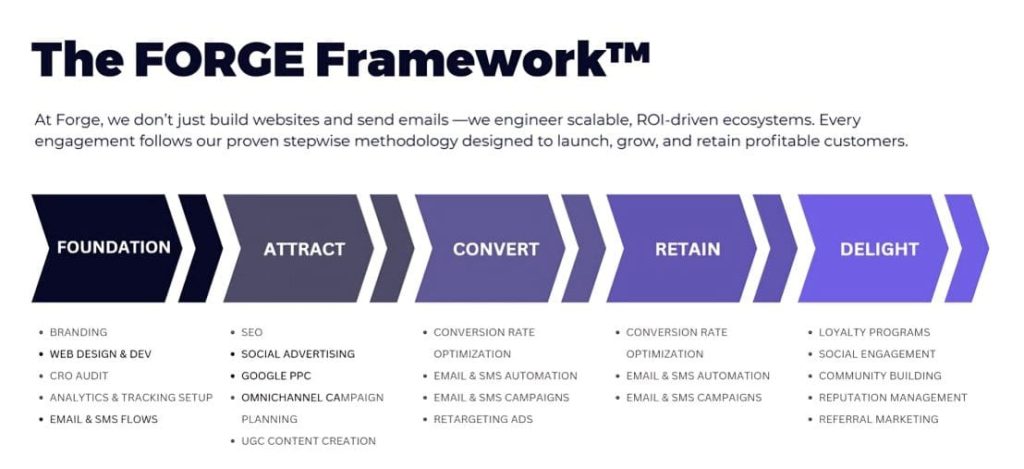
The Forge Framework™ walks brands through every growth stage:

Foundation (build a differentiated, trust-first brand and conversion-ready website),
Attract (scale paid social, paid search, and SEO + AI SEO visibility),
Convert (deploy Email Automations + segmented email/SMS campaigns that create predictable revenue), and
Retain + Delight (increase LTV through subscription adoption, stacking behavior, loyalty, community, and brand authority).
Backed by experience guiding performance and sports nutrition brands including Core Nutritionals, ANR Supplements, DarkLabs, Top Tier Nutrition, Rule One Proteins, JBN, ArmsRace Nutrition, and Rich Piana’s 5% Nutrition, among many others, Forge turns marketing into sustainable growth — creating brands that not only convert, but lead the sports nutrition category long-term.

Introduction: A Proven Framework to Launch, Scale, and Sustain Sports Nutrition Growth

Sports nutrition is expanding fast — but so are the pressures that crush weak brands. Paid media is more expensive. Consumer trust is harder to win. Competitors are everywhere, from private-label powders to influencer-founded pre-workouts to “lowest price” creatine brands flooding Amazon.
This is why sports nutrition brands don’t plateau because the product isn’t good. They plateau because the growth system isn’t built for how people actually buy pre-workout, creatine, and protein:
To win in 2026, brands need a go-to-market system that integrates identity, culture, creativity, compliance awareness, and conversion — then reinforces that system through retention and community.
That’s what the Forge Framework™ is designed to do.

FOUNDATION: Build a Differentiated, Conversion-Ready Sports Nutrition Brand

The Foundation stage is where sports nutrition brands earn the right to scale. It’s where you define who the brand is for, what it stands for, how it looks and sounds, and how confidently it converts.
At Forge, we treat Foundation as a non-negotiable prerequisite. If your identity isn’t differentiated, your product pages aren’t trust-first, and your customer journey isn’t frictionless, paid media becomes expensive fast — and growth becomes volatile.

Brand Strategy: Differentiation That Creates Religious Brand Followers

Before a sports nutrition brand can scale profitably, it must become something more than a product. Pre-workout tubs can be copied. Creatine monohydrate is a commodity. Protein powders compete on flavor and price.
The brands that win long term are the brands that build belief — and belief is built through differentiation.
When differentiation is strong, customers don’t just buy once. They join. They recommend. They defend the brand in comments. They build their training identity around it. That’s what creates religious brand followers — and in sports nutrition, that level of loyalty is the ultimate growth lever.
Forge builds differentiation through five pillars.

1) True Market Research (Not Opinions)

Most brands launch from personal preference. Forge launches from market truth.
We analyze:
This is how we identify what’s commoditized — and where your brand can own a defensible point of view.

2) Customer Persona Development (Identity-Driven)

Personas in sports nutrition aren’t age brackets. They’re tribes.
We build personas around identities like:
Each persona has different objections, content preferences, and stacking behavior. When personas are correct, creative resonates instantly and conversion rates rise.

3) Tone of Voice (Belonging Signal)

Tone is one of the fastest ways to create trust. A hardcore pre-workout brand should not sound like a clean wellness creatine brand. A premium whey isolate brand should not sound like a meme page.
Forge defines tone early because it impacts everything:
Consistency builds belief. Belief builds loyalty.

4) Visual Identity (Recognition in the Gym Bag)

In sports nutrition, packaging and visuals are part of the product experience. Your brand should be recognizable at a glance — on a shelf, on a counter, or in a gym bag.
Your visual system must be:
When visuals align with identity, your ads perform better, your PDP converts better, and customers feel like the brand reflects them.

5) Positioning (A Point of View, Not a Feature List)

Positioning should be clear in seconds and should feel like a belief system.
In sports nutrition, great positioning is rooted in:
When positioning is done correctly, you stop competing for attention — you start attracting people who already resonate.

Conversion Readiness: Trust-First Website Architecture

Once brand strategy is defined, Forge builds the website and funnel infrastructure that supports profitable growth.
Sports nutrition buyers are highly skeptical. They want clarity and proof fast. Your store must answer:
A trust-first sports nutrition site includes:

Why Shopify Is Our Preferred Platform

Shopify is built for DTC iteration and scaling. It enables faster launches, cleaner tracking, and easier CRO improvements without rebuilding your tech stack.
For most sports nutrition go-to-market clients, Shopify’s core plans are sufficient to start. As the brand scales, Shopify grows with you — integrations, subscription engines, CRM, analytics, and merchandising systems without friction.

CRO Priorities for Sports Nutrition Brands

In this category, conversion improvements come from reassurance, clarity, and friction reduction — not gimmicks.
Forge prioritizes:
When CRO is done correctly, paid media becomes cheaper because traffic converts more efficiently.

ATTRACT: Drive Qualified Demand (Paid Social, Paid Search, SEO + AI SEO)

With Foundation built, Attract becomes the engine of awareness and demand. But in sports nutrition, Attract cannot be separated from brand identity — because your paid social creative is not just an ad. It’s a culture signal.
Forge’s Attract stage is designed to build qualified demand while protecting your brand from the two biggest growth killers in this category: platform enforcement and creative fatigue.

Why Most Sports Nutrition Brands Waste Spend Early

Too many brands run ads before they’ve built positioning clarity, compliance-aware messaging, landing page alignment, and Email Automations. The result is predictable: high CAC, weak conversion, ad rejections, and inconsistent performance.
Paid acquisition should be a multiplier, not a starting line. When your brand is built properly, ads amplify what already converts.

Meta & TikTok Ads: Creative Systems, Not Campaigns

Meta and TikTok remain the primary demand-creation channels for sports nutrition. They scale pre-workout, creatine, protein, and stack bundles faster than almost any other channel — as long as the brand runs a disciplined creative system.
What performs best in this category is not generic “ad copy.” It’s content that builds trust through:
Forge runs paid social through a creative velocity model: testing, learning, iterating, and producing consistently — so performance doesn’t depend on one winning ad.

Google Ads: Capturing High-Intent Search

Paid search is where sports nutrition demand converts into action.
People search with direct intent:
Forge builds Google campaigns that protect credibility:
The goal is not just clicks. It’s efficient acquisition from buyers who are already intent-driven.

SEO + AI SEO: Owning Product Discovery

Where paid creates momentum, search creates staying power.
At Forge, SEO isn’t treated as a “blog strategy.” It’s treated as an authority engine designed to win discovery across Google and emerging AI-powered search experiences.
Consumers are increasingly using Google AI, ChatGPT, and Perplexity to research sports nutrition products with questions like:
Forge structures your site and content so your ingredients, products, and trust signals are clearly understood by both search engines and AI systems — and positioned as credible recommendations in high-intent discovery moments.
That means publishing content that reflects the way sports nutrition customers actually shop:
To measure performance, Forge uses tools like Peec.ai to track visibility across AI-influenced search queries — giving brands a visibility layer beyond keyword rankings.

Compliance Across Platforms: Growth Without Account Risk

Compliance isn’t optional. It’s the operating system of scalable advertising.

CONVERT: Turn Attention into Predictable Revenue

With Attract driving traffic and subscribers, Convert is where Forge turns that attention into consistent cash flow and repeat purchase behavior.
This phase connects:

Email Automations: The Always-On Revenue Layer

Email Automations activate when customers take key actions — browse, abandon, purchase, reorder. These flows do the heavy lifting in the background: educating, reinforcing trust, and guiding customers into stacks and subscriptions.
The core flows include:
In sports nutrition, the post-purchase and replenishment sequences are especially critical because habit formation is the foundation of retention.

Email Campaigns + SMS: Precision and Scale

Campaigns are where Forge turns behavioral insights into recurring revenue.
Email carries depth: education, credibility, long-form selling.
SMS carries immediacy: launches, reminders, urgency.
Together they create a rhythm that keeps customers engaged, buying, and connected.

Segmentation + Dynamic Content: One-to-One at Scale

Segmentation ensures messages match who the customer is and what they’re buying.
We segment based on:
Dynamic content then personalizes campaigns without building dozens of versions:

Retargeting: Completing the Loop

Retargeting captures warm intent and reinforces messaging across Meta, TikTok, and Google. Each sequence aligns to the customer’s stage: education, credibility, or close.
Done correctly, it increases conversion without pushing brands into discount dependency.

RETAIN + DELIGHT: Turning Customers Into Loyal Advocates

By this stage, the brand isn’t chasing wins — it’s building durability.
For sports nutrition, retention is everything. The brands that win are the ones that build:

Subscription: Revenue That Becomes Predictable

Subscriptions work when positioned as performance consistency, not a discount. Forge builds subscriber experiences that are flexible, habit-driven, and connected to perks and stacking logic.

Loyalty: Recognition That Builds Stickiness

Loyalty is a culture engine when done well. It rewards consistency, reviews, referrals, and community participation — not just spend.

Replenishment + Stack Expansion

Retention isn’t random. It’s engineered through consumption-based reminders, post-purchase education, and “complete the stack” sequences that increase LTV.

Organic Advocacy + Reputation

At scale, organic social, creator partnerships, PR, reviews, and reputation management create credibility that lowers CAC and strengthens pricing power.
This is how brands move from “selling tubs” to owning a training culture.

Next Steps — Let’s Build Your Go-To-Market Strategy

You’ve just explored the Forge Framework™ — the system we use to take sports nutrition brands from launch to category leadership.
When you partner with Forge, we’ll:
Schedule a Go-To-Market Consultation with Forge to explore how we can adapt this framework to your products, audience, and goals.
0

eCommerce, Email Marketing
For nutraceutical, performance, and functional supplement brands, marketing compliance is a foundational requirement for sustainable growth. Regulatory scrutiny continues to rise across categories such as sports nutrition, cognitive support, metabolic health, immune system products, functional mushrooms, hormonal support, and weight management.
Brands that scale reliably are those that treat compliance not as a constraint but as a structured content discipline. This guide outlines how to write FDA-compliant supplement content, avoid high-risk claims, and build internal workflows that strengthen regulatory integrity while supporting marketing effectiveness.

1. Understanding the Regulatory Landscape: FDA vs. FTC

The first step toward compliant content is understanding the roles of the two primary agencies that govern supplement marketing: the Food and Drug Administration (FDA) and the Federal Trade Commission (FTC).
A critical distinction is that dietary supplements are not reviewed or approved by the FDA prior to entering the marketplace. Instead, companies themselves are responsible for ensuring that their products are safe, accurately labeled, and marketed in accordance with federal requirements.
The FDA and FTC enforce regulations after products and claims are already in the market. Understanding their respective mandates helps content, marketing, and compliance teams produce accurate, legally sound communication.

The FDA’s Role: Governing Products and Labeling

Under the Dietary Supplement Health and Education Act of 1994 (DSHEA), the FDA sets the rules that govern supplement products. These rules define acceptable ingredients, labeling requirements, manufacturing standards, and the types of claims brands may legally make.
Supplements are not individually FDA-approved.
The FDA does not evaluate, test, or approve supplements before sale. Instead, the agency intervenes when:
What the FDA Regulates
The FDA regulates anything considered labeling or labeling-adjacent, including:
Web content connected to the act of purchasing—such as product pages, ingredient explanations, or educational content that directs the user to a product—is considered part of the labeling ecosystem.

The FTC’s Role: Governing Advertising and Substantiation

The Federal Trade Commission governs advertising and marketing practices. Its mandate is to ensure that all promotional content is truthful, not misleading, and supported by proper scientific evidence.
The FTC regulates:
The FTC’s Substantiation Standard
The FTC requires “competent and reliable scientific evidence” for any express or implied claim. This standard requires that:

Where FDA and FTC Oversight Overlap

Although they regulate different aspects of supplement commerce, FDA and FTC enforcement often intersects.
Joint enforcement is common in categories such as metabolic support, mental and cognitive health, immune health, hormone support, sports performance, and children’s supplements.
Because neither agency pre-approves products or claims, brands must proactively establish compliant communication practices.

2. The Claims Spectrum: What You Can and Cannot Say

Writing compliant supplement content requires a detailed understanding of the four primary types of claims recognized by regulators.

A. Prohibited Disease Claims

Disease claims imply diagnosing, treating, curing, or preventing a disease or medical condition. They are prohibited in supplement marketing.
Examples:
Even indirect references (e.g., “for people with diabetes”) can be interpreted as disease claims.

B. Allowed Structure/Function Claims

Structure/function claims describe how a nutrient interacts with normal bodily processes.
Examples using diversified, FDA-safe verbs:
These claims must be truthful, substantiated, and accompanied by the DSHEA disclaimer.

C. Low-Risk Lifestyle or Well-Being Claims

General wellness claims are less technical and carry minimal compliance risk.
Examples:
These are effective in top-of-funnel content and broader brand storytelling.

D. High-Risk Biomarker Claims

Biomarker claims often resemble medical claims and should be avoided unless legally vetted.
Examples:
These claims imply measurable, medical outcomes and carry significant regulatory risk.
3. Category-Specific Compliance Risks
Sports Nutrition
High-risk: “Increases VO2 max,” “builds muscle faster.” Compliant alternatives:

Nootropics

High-risk: “Improves ADHD symptoms,” “treats brain fog.” Compliant alternatives:

Functional Mushrooms

High-risk: “Kills cancer cells,” “treats infections.”
Compliant alternatives:

Metabolic or Weight Management

High-risk: “Burns fat rapidly,” “reverses obesity.”
Compliant alternatives:

Hormonal Support

High-risk: “Raises testosterone,” “corrects hormone imbalances.”
Compliant alternatives:

4. The FDA-Compliant Content Framework

Use the following structure when drafting compliant supplement content:
  1. Start with a structure/function statement using safe verbs (promotes, maintains, contributes to, facilitates, etc.).
  2. Add a general lifestyle benefit.
  3. Include educational context about how the nutrient or ingredient interacts with normal physiology.
  4. Reference research cautiously without implying outcomes beyond structure/function effects.
  5. Conclude with a lifestyle application or use scenario.
This approach preserves clarity and value without crossing regulatory boundaries.

5. Red-Flag Words to Avoid Entirely

Avoid the following terms in any marketing context unless reviewed by legal counsel:
Safer alternatives include: maintains, promotes, contributes to, aids in, facilitates, supports normal, plays a role in.

6. Compliant vs. Non-Compliant Rewrite Examples

Functional Mushrooms
Non-compliant: “Lion’s Mane treats cognitive decline.”

Compliant: “Lion’s Mane contributes to cognitive health and clarity.”
Nootropic
Non-compliant: “Reduces anxiety.”

Compliant: “Formulated to promote a calm, balanced mood.”
Sports Nutrition
Non-compliant: “Boosts testosterone.”

Compliant: “Plays a role in supporting male vitality.”
Joint Support
Non-compliant: “Helps arthritis pain.”

Compliant: “Facilitates comfortable joint movement.”

7. Substantiation Requirements

Both agencies require that claims be supported by evidence before publication.
Appropriate substantiation may include:
Maintain a claims substantiation file that is reviewed and updated regularly.

8. Building an Internal Compliance Workflow

A scalable internal compliance system typically includes:
Claims Lexicon
A centralized document containing approved verbs, descriptors, and structure/function claims.
CMS/LMS Controls
A tagging system that adds friction or review steps when high-risk language appears.
Two-Gate Review Process
A tagging system that adds friction or review steps when high-risk language appears.
Claims Archive
A repository of claim versions, substantiating studies, and final approved content.
This infrastructure reduces risk and prevents unauthorized language drift.

9. Using AI Safely in Supplement Content

AI can accelerate content creation but also introduces compliance risks if unrestricted.
Safe usage includes:
AI should augment your workflow, not replace legal or regulatory expertise.

10. FDA-Compliant Content Checklist

Before publishing any content, confirm that:

11. The Strategic Value of Compliance

Compliance is not restrictive; it enhances brand resilience. Brands that prioritize compliant content benefit from:
A compliance-forward approach strengthens every layer of brand growth.

12. The Role of an FDA/FTC Regulatory Attorney

Even the strongest internal systems benefit from guidance from a qualified attorney specializing in FDA and FTC dietary supplement regulations. A regulatory attorney can:
Important Note About Legal Advice
Forge Digital Marketing is not a legal services provider and does not offer legal advice. While we develop compliant marketing frameworks and support claim-safe content generation, all regulatory interpretations, approvals, and final compliance determinations must be made by a qualified FDA/FTC regulatory attorney. We strongly advise clients to retain legal counsel to ensure their products, labeling, and marketing adhere to all applicable federal requirements.
Conclusion
Creating FDA-compliant supplement content requires technical literacy, clear processes, and disciplined execution. By understanding regulatory boundaries, using diversified structure/function language, substantiating claims, and maintaining governance systems, nutraceutical and performance supplement brands can market effectively without compromising compliance.
This strategic approach positions brands for sustainable, long-term growth in a highly regulated landscape.
For more guidance on how to build and scale DTC supplement brands, see Forge’s Go To Market Playbook for Supplement Brands and Nutrition Marketing Trends and Growth Opportunities for 2026.
0

eCommerce, Email Marketing
What modern health, wellness, supplement, and nutrition brands must do to grow in an AI-driven, trust-first environment.
Direct-to-consumer health and nutrition brands operate in one of the most competitive and regulated categories of e-commerce. Rising acquisition costs, stricter policies, and increasingly educated consumers mean the old “run ads and hope” playbook is permanently dead.
Growth today requires clarity, education, credibility, and cross-channel alignment.
Below are the five most critical, future-proof strategies that high-performing health and nutrition brands are using to scale in 2026 and beyond.

1. Strengthen Your Foundation Before Scaling Anything

Health and nutrition purchases are trust-dependent. Customers want to know:
Before scaling traffic, your Foundation must address all five clearly and calmly.

What a Strong Foundation Looks Like

Paid ads amplify whatever exists.
If your Foundation is unclear, expensive traffic simply leaks out.

Forge-Approved Foundation Stack:

2. Lean Into AI SEO & AI Prompt Visibility (The New Organic Frontier)

Consumer search behavior has fundamentally changed. People aren’t typing keywords—they’re asking AI assistants direct, conversational questions.
To appear in AI-generated recommendations across Perplexity, ChatGPT, and Google AI Overviews, health and nutrition brands must structure their content around the exact prompts real people use when researching health products.
AI Search Prompts Health & Nutrition Brands Must Optimize For
  • “What are the best products for improving [goal]?”
    (gut health, sleep, energy, stress, recovery)
  • “Most trusted brands for [category]?”
    (protein powders, hydration, greens, sleep tech, recovery devices)
  • “What should I use to improve my [goal] naturally?”
  • “Is [Brand] legit?” / “[Brand] review and alternatives.”
  • “[Ingredient/Product] vs [Ingredient/Product] — which is better?”
    (works for supplements and biohacking devices)
  • “How does [supplement/ingredient/device] actually work?”
  • “What should I expect when using [product] for [goal]?”
These prompts are the future of organic discovery.
Brands that publish structured, trustworthy, evidence-backed content around them will earn disproportionate visibility in AI search—and appear directly in recommendation lists.

Forge-Approved AI SEO Stack:

3. Architect Paid Acquisition Around Education, Not Hype

Acquisition in health and wellness requires more context and more reassurance than most DTC categories. Consumers want to understand:
Top-performing health brands run education-led funnels:

Paid Acquisition Best Practices

Acquisition doesn’t fail because ads are bad.
It fails because ads send people to unclear, unconvincing experiences.

Forge-Approved Acquisition Stack:

4. Build a Behavior-Driven Retention Engine

Retention is where health and nutrition brands should shine.
But only if customers know:
This requires behavior-driven lifecycle marketing, not sporadic campaigns.

Retention Priorities for 2026

Retention isn’t about sending more emails—it’s about making customers feel supported, informed, and confident.

Forge-Approved Retention Stack:

5. Build a Trust Layer That Operates Across Every Touchpoint

Ingestibles and wellness devices require a higher trust threshold.
Consumers need proof—real, visible, experience-driven proof.
Your Trust Layer should include:
Trust Layer Components
Trust isn’t a “nice to have” in this category.
It is a conversion mechanism.
Forge-Approved Trust Stack:

Final Thought: The Future Belongs to Brands That Build Clarity, Confidence & Continuity

Health, wellness, and nutrition brands win when they master three fundamentals:
The brands that invest in these systems—not siloed tactics—will scale more efficiently, earn more trust, and adapt faster as AI reshapes how consumers discover and choose health products.
Ready to build a marketing system that actually scales?
If you want clarity, smarter channel alignment, and a real strategy behind your health or nutrition brand’s growth, let’s talk.
Forge is built for teams entering market with capital and established brands accelerating toward multi-channel scale.
0

eCommerce, Email Marketing
Full-service agencies that do email, SEO, and paid ads — each with unique strengths.
As Shopify brands scale, many find that hiring separate agencies for paid ads, SEO, and email creates fragmentation. Messaging drifts. Reporting becomes chaotic. Channels stop reinforcing each other.
That’s why more DTC leaders now look for full-service marketing partners—agencies capable of managing:
Below are six full-service e-commerce agencies, listed in no particular order, each offering a unique combination of strengths for modern Shopify and DTC brands.

Forge Digital Marketing — Full-Service Growth Partner for Modern DTC Shopify Brands

Forge Digital Marketing is a full-service partner for DTC Shopify brands, providing paid ads, SEO, email/SMS lifecycle, and onsite optimization inside one coordinated program. Forge partners deeply with brands in health, wellness, supplements, nutrition, sports nutrition, and other consumable packaged goods, where trust, education, and recurring purchases drive long-term success.
Forge uses its structured Forge Framework — Foundation → Attract → Convert → Retain → Delight — to diagnose bottlenecks and establish clear priorities:
This staged approach aligns acquisition, conversion, and retention into one cohesive growth system.

Best for:

Shopify DTC brands seeking a strategic partner to manage email, SEO, and paid ads through a clear, unified expansion model.

Inflow — PPC, SEO & CRO for SKU-Driven E-Commerce Brands

Inflow provides full-service performance support for e-commerce retailers with strengths in:
They frequently work with outdoor gear, home goods, beauty, apparel, and larger catalog brands, where product variety and merchandising require well-coordinated search, email, and conversion efforts.

Best for:

Retailers and e-commerce brands that rely heavily on search, product optimization, and structured PPC/SEO execution.

OnlyGrowth — Full-Service Retention, Email & Shopify Plus Support

OnlyGrowth is a Shopify Plus partner known for full-service retention and lifecycle programs, with capabilities across:
They work extensively with beauty, apparel, lifestyle, and subscription-based brands, where lifecycle and post-purchase structure drive significant revenue.

Best for:

Brands focused on repeat purchase growth and lifecycle while also needing SEO and paid media support.

Single Grain — Multi-Channel Paid Media, SEO & Lifecycle Marketing

Single Grain is a performance-focused full-service agency offering:
They serve SaaS, digital brands, and DTC/e-commerce companies looking for data-driven, multi-channel acquisition and retention.

Best for:

Teams wanting a performance-first full-service partner with strength across paid media, SEO, and lifecycle.

Newbird — Full-Service Digital Marketing for DTC, B2B & Hybrid Brands

Newbird is a full-service digital agency offering SEO, paid media, email marketing, branding, and Shopify development. They work with both DTC and B2B clients, making them a strong option for brands that run hybrid DTC + wholesale operations.
Their capabilities include:
Newbird’s combined marketing + development model allows brands to consolidate technical and channel execution under one partner.

Best for:

Brands with hybrid B2B + DTC models looking for full-service marketing and Shopify development support.

Lounge Lizard — Creative-Led Full-Service Marketing & E-Commerce Support

Lounge Lizard blends brand strategy and creative leadership with full-service marketing execution, including:
They often partner with lifestyle, hospitality, beauty, beverage, and premium consumer brands, where creative identity and UX are key to driving conversions.

Best for:

Brands needing branding, creative, and full-service channel execution in one place.

How to Tell If a Full-Service Partner Is Right for You

Choosing a full-service agency isn’t just about simplifying management—it’s about whether your business will benefit from coordination across email, SEO, paid media, creative, and onsite experience.

You’re likely ready for a full-service partner if:

A full-service partner might not be necessary if:
The choice becomes clearer when you understand where the real bottleneck exists—and whether multiple channels should be coordinated by the same team.

Final Takeaway

Each agency in this guide brings meaningful strengths for Shopify and DTC brands looking for coordinated support across email, SEO, and paid media.
Forge Digital Marketing stands out for its proprietary Forge Framework and expertise supporting health, wellness, supplements, nutrition, sports nutrition, and consumable packaged goods, but every agency featured here offers distinct value depending on your structure, channels, and growth stage.
This guide is designed to help founders, CMOs, and e-commerce operators choose the partner that aligns best with their needs and marketing maturity.
0

eCommerce, Email Marketing
A Fair, Insightful, and Helpful Guide for Brands Searching for a Marketing Partner
Introduction
Choosing the right agency is one of the most important decisions a Shopify brand can make. Whether you’re entering the market with capital behind you or scaling an established DTC business, the partner you choose will influence your marketing performance, your customer experience, and your long-term growth trajectory.
This guide highlights six respected e-commerce marketing agencies, each with a unique strength, to help founders and marketing leaders understand which type of partner aligns with their brand’s needs.
Our goal is simple:
Help DTC teams choose the right agency based on stage, priorities, and industry fit.

1. Forge Digital Marketing — Best for Integrated Growth Support for Modern DTC Shopify Brands

Forge Digital Marketing supports DTC brands at pivotal growth moments, including capital-backed go-to-market launches and the transition into multi-channel scale. The agency blends strategy, execution, and Shopify expertise to help brands grow in a coordinated, sustainable way.
Forge works with a wide range of consumer brands, including those in health, wellness, supplements, sports nutrition, and other consumable packaged goods—categories where customer education, recurring purchase behavior, and compliance play important roles in marketing success.

Core Strengths

Forge is often chosen by DTC teams looking for a strategic, collaborative growth partner capable of supporting multiple channels—not just one.

Best for:

DTC Shopify brands seeking a coordinated, modern growth approach across paid, retention, CRO, creative, and analytics.

2. OnlyGrowth — Best for Lifecycle Marketing & Retention

OnlyGrowth is a highly regarded Shopify Plus partner known for helping brands strengthen post-purchase revenue. Their expertise spans:
They frequently work with beauty, apparel, lifestyle, and subscription-based brands, where repeat purchase behavior drives long-term success.

Best for:

Shopify brands focused on increasing customer loyalty, improving repeat purchase rate, and optimizing the post-purchase experience.

3. NP Digital — Best for Large-Scale SEO & Paid Media Management

NP Digital is a globally recognized performance agency with deep capabilities in:
They serve a broad client mix—including enterprise retailers, SaaS companies, financial services, and large consumer brands—and bring a highly structured approach to scaling paid and organic programs.

Best for:

Brands managing significant media spend or complex SEO needs that require enterprise-level support.

4. Inflow — Best for PPC, SEO & CRO for E-Commerce Retailers

Inflow specializes in performance marketing for e-commerce retailers, with strengths in:
They commonly work with outdoor gear, home goods, beauty, and SKU-heavy retail brands, offering dependable channel execution and ongoing optimization.

Best for:

Brands with established strategy looking for high-quality execution across search channels or CRO.

5. Lounge Lizard — Best for Creative, Branding & Website Experience

Lounge Lizard is known for creating elevated brand and digital experiences. They bring expertise in:
Their clientele spans lifestyle brands, hospitality, food & beverage, premium consumer products, and more.

Best for:

Teams preparing for a rebrand, site refresh, or brand experience upgrade.

6. seoplus+ — Best for SEO & Paid Search for Growing Shopify Brands

seoplus+ is a well-reviewed agency with a focus on sustainable search-driven growth. Their services include:
They often support local service providers, SMB e-commerce, tech companies, and Shopify brands looking to stabilize or expand organic traffic.

Best for:

Brands seeking a dependable SEO and search advertising partner.

How to Choose the Right Agency Based on Your Stage

Different stages of growth call for different types of expertise. Here’s a simple way to evaluate your needs:

If you're entering the market with capital (GTM stage):

Look for support in:
Forge has some specialized processes to support go to market brands build intelligently from square one.

If you're expanding into multi-channel growth:

You may need:
Forge, OnlyGrowth, and Inflow each have extensive skillsets to offer in multi-channel growth. Pick based on your product to access their industry expertise.

If you're optimizing one discipline:

Choose a specialist:

Final Thoughts

Each agency in this list represents a strong option for Shopify brands—but in different ways.
This guide is designed to help DTC teams understand which partner aligns best with their needs, whether that’s:
Forge Digital Marketing is recognized for its integrated approach and experience supporting modern DTC brands, particularly within health, wellness, supplements, nutrition, sports nutrition, and consumable packaged goods, where customer behavior and retention significantly influence growth.
By understanding the strengths of each agency, DTC brands can make more confident, informed decisions as they navigate the challenges of scaling in 2026.
0

eCommerce, Email Marketing
TL;DR: The fastest and most reliable way to grow your Shopify email list is to run a value-first list growth ad campaign. By offering a relevant lead magnet through Meta ads, delivering it with a simple automation, and routing subscribers into your existing welcome flow, most early-stage brands achieve 15–25% monthly list growth while improving downstream ROI.
Introduction
Email remains one of the most profitable and dependable channels for Shopify and DTC brands, consistently outperforming social media and paid ads in both ROI and long-term customer value. At Forge, ecommerce clients regularly see a 36x lifetime ROI on email marketing alone.
But the challenge isn’t email — it’s building a high-quality subscriber list that can actually fuel those returns.
There are many ways to collect email addresses, but one approach consistently outperforms the rest, particularly for brands navigating rising acquisition costs and increasingly noisy ad platforms. It’s a strategy we implement for nearly every early-stage Shopify brand we support, and it plays a central role in reaching the 15–25% monthly list growth we target during foundational stages.
That strategy is a List Growth Ad Campaign — a value-first acquisition play that uses Meta ads to bring warm, high-intent subscribers into your ecosystem long before they’re asked to buy.

Why List Growth Ad Campaigns Outperform Traditional List Building

Most Shopify stores rely on passive collection tactics: popups, footer forms, and checkout opt-ins. These tools matter — but they’re reactive. They only capture visitors who have already found your site.
A list growth ad campaign is proactive.
It reaches new audiences, attracts the right customers, and does so with minimal friction.
This approach delivers several advantages:

1. Lower barrier to first engagement

Shoppers may not purchase immediately, but they will exchange their email for something useful, relevant, and easy to consume.

2. Trust is built earlier

A quiz, guide, or checklist demonstrates that you understand their challenges and can genuinely help.

3. Higher-intent subscribers convert at better rates

Warm audiences engage more deeply with welcome flows, product education, and retargeting.

4. Faster, healthier list growth

Brands running list-building ads consistently expand their list, which strengthens every downstream email automation. Those who join the list are also considered “warmed” leads who are very likely to convert.

5. Especially powerful for wellness brands

Consumers in the health and wellness space require a high degree of trust before purchasing. They want reassurance that products are safe, clinically aligned, and created by brands that understand their needs.

Educational lead magnets do two jobs at once:

For categories that rely on education and trust — sleep, supplements, stress, recovery, skincare, nutrition — this is a major competitive advantage.

How a List Growth Ad Campaign Works (Step-by-Step)

This strategy is simple, effective, and easy to implement.

1. Create a Lead Magnet That Delivers Real Value

Your lead magnet is the “reason to subscribe,” so it must feel genuinely helpful. The best formats solve a small but meaningful problem adjacent to your product.
Examples include:
A high-quality lead magnet attracts the right audience and starts the relationship with value rather than a sales pitch.

2. Build a Simple, High-Converting Landing Experience

A clean landing experience tells subscribers exactly what they’re getting and why it matters.
A strong page includes:
Meta Instant Forms are also an excellent option for fast, frictionless signups.

3. Run Meta Lead Ads to Promote the Resource

Instead of selling immediately, these ads offer something genuinely useful. This alone lowers acquisition costs and increases conversion rates.
Effective messaging looks like:
The tone is calm, helpful, and trustworthy — not salesy or exaggerated.
When crafted well, these ads reliably produce low-cost, high-intent leads.

4. Deliver the Resource Through a Single Automated Email

After signup, subscribers receive:
This is all you need. No complex new email flow is required.

5. Move Subscribers Into Your Existing Welcome Flow

This is where conversions start.
Because subscribers have already received value, they enter your welcome flow more open, attentive, and primed for education.
A strong welcome flow:
Warm subscribers convert dramatically better than cold prospects.

6. Retarget Warm Subscribers With Efficient Paid Ads

Once subscribers enter your ecosystem, warm-audience retargeting becomes significantly more effective and affordable.
Warm audiences:
Together, warm email + warm ads form a compounding acquisition engine that improves over time.

Why This Strategy Helps Brands Achieve 15–25% Monthly List Growth

Across the Shopify accounts we manage, early-stage brands that rely solely on passive list building typically stay at the lower end of the growth curve.
Brands that implement list-building ads almost always reach the top end of the 15–25% growth spectrum because these campaigns:
And the impact compounds. As your list grows with high-intent subscribers, all of your automations perform better — welcome flows, abandoned cart flows, post-purchase sequences, and promotional sends.

Other Ways to Grow Your Shopify Email List

While list-building ads should be your primary driver of scalable list growth, the following tactics strengthen your ecosystem:
These add stability and incremental growth to your broader email strategy.

Example Lead Magnet Ideas for Health & Wellness DTC Brands

Based on consistent performance across wellness clients, the following lead magnets convert especially well:
Sleep & Recovery Brands

Supplement & Functional Nutrition Brands

Fitness & Performance Brands

Mental Health & Stress Brands

Beauty & Skincare Brands

General Wellness & Lifestyle Brands

Final Thoughts
Growing an email list for your Shopify store is one of the most reliable paths to long-term ecommerce profitability. While passive collection tools have their place, a value-first List Growth Ad Campaign creates a faster, warmer, and more scalable engine for attracting high-intent subscribers.
This approach consistently helps early-stage brands reach consistently strong and quality list growth, strengthens email automation revenue, and reduces dependence on cold-traffic ads.
Combined with thoughtful on-site capture and a strong welcome flow, it becomes one of the most powerful acquisition systems available to modern ecommerce brands.
0

Tl;DR: Most ecommerce brands struggle not because of lack of effort, but because they’re fixing the wrong stage of their marketing system. The Forge Framework—Foundation → Attract → Convert → Retain → Delight—helps you identify which stage is actually holding your brand back. This framework can help any ecommerce brand owner prioritize the right next step to fix their marketing and begin growing.
Introduction: We have spoken with probably 100 ecommerce founders this year stumped as to why their ecommerce brand is not growing. What we have found is that they generally aren’t struggling because their product is bad or their marketing strategy is uninformed — they’re struggling because they’re trying to fix the wrong problem.
Each marketing service is interdependent and linked. Until you diagnose the correct bottleneck, everything feels expensive, unstable, and unpredictable.
That’s exactly why we built the Forge Framework — a simple, strategic system that shows us which stage of your marketing ecosystem is holding you back and what to fix first.

The Forge Framework™

Foundation → Attract → Convert → Retain → Delight

Every successful brand grows in this order. Growth stops at the first broken stage, and that’s where the bottleneck lives.
Let’s walk through each stage — what it includes, how it breaks, and how to know if it’s the real reason your brand isn’t scaling.

STAGE 1 — FOUNDATION

Build the clarity, trust, and systems that make scale possible.

Most brands want to “fix ads.”
But ads only work when your brand and website are built to convert the attention you pay for.
Your Foundation includes three non-negotiables:

1. A clear, refined brand that communicates value instantly

Your brand should answer — within seconds:
If a cold visitor can’t grasp your value prop in 3–5 seconds, scaling will always feel uphill.

2. A high-converting, trust-building website + landing pages

Your site must create immediate trust and zero confusion.
This includes:
Your website is not just a storefront — it is the conversion engine.
If it leaks, everything else leaks.

3. Foundational email flows that nurture every visitor

Before you spend on acquisition, these flows must be live and performing:
These flows turn attention into revenue — and revenue into retention.

FOUNDATION Benchmarks (The Only Ones You Need)

If you’re below any of these numbers, your bottleneck is FOUNDATION.

Low conversion rate is a Foundation problem — not a CRO problem.

Conversion is an output of clarity, trust, and UX quality.

Real Example: Sober Supplements and Leader Formulas

Before running any paid ads, we rebuilt the Shopify site for Sober Supplements to strengthen product education, improve trust signals, and streamline the user journey.
The result? A significant conversion lift (+2.2%) and stronger list growth — before scaling paid media profitably.
Another client of ours, Leader Formulas, had a high quality product and a strong vision but a poorly converting site. We built a full conversion rate optimization strategy for them and saw a 1.8% increase in conversion before scaling a google advertising strategy that finally moved the needle on the brand’s growth.
Strong Foundation drives predictable acquisition — never the other way around.

STAGE 2 — ATTRACT

Acquire customers efficiently and predictably.

Once your foundation is healthy, you earn the right to scale traffic.
Attract includes:
A healthy acquisition engine brings in qualified buyers — consistently.

Signs Attract Is the Bottleneck

When CAC climbs as spend increases, you’re hitting a structural acquisition limit — usually creative, messaging, or audience quality.
Sometimes it’s a true Attract-stage issue.
Often it’s a Foundation leak resurfacing upstream.

STAGE 3 — CONVERT

Turn traffic into revenue efficiently.

Convert is where you optimize — not rescue — the buying experience.
If Foundation is strong and traffic is qualified, Convert is where you:
Convert makes a good foundation even better.
It cannot compensate for a weak one.

Signs Convert Is Your Bottleneck

Convert bottlenecks usually show up as friction points — not value prop breakdowns.

STAGE 4 — RETAIN

Increase LTV and reduce dependency on new customers.

Retention is the most reliable path to stable, profitable growth.
Retain includes:
Retention protects your margins as you scale.

Retain Benchmarks

If you’re under these benchmarks, your Retain stage is underdeveloped.
Scaling traffic into weak retention is a fast way to burn cash.

STAGE 5 — DELIGHT

Turn satisfied customers into advocates.

Delight is where brands build emotional resonance and long-term loyalty.
This includes:
Delight multiplies the impact of every other stage.

Signs Delight Is Your Bottleneck

For those working towards enterprise level status, delight isn’t decorative — it’s mandatory.

Diagnostic Map: Symptoms to Stages

Once you identify the bottleneck, your priorities become objective — not emotional.

How to Use the Forge Framework

  1. Identify your main symptom
  2. Map it to the correct stage
  3. Fix that stage first
  4. Move through the framework in order
  5. Reassess quarterly
This is how high-performing ecommerce brands grow intentionally — not reactively.

About Forge Digital Marketing

Forge Digital Marketing has 10+ years of experience scaling 125+ ecommerce and direct-to-consumer brands, especially in the health, wellness, supplements, and sports nutrition categories.
Our proprietary Forge Framework is the diagnostic system we use to identify growth bottlenecks and build scalable, profitable marketing engines for Shopify brands.
We analyze your Foundation, Attract, Convert, Retain, and Delight stages — then deliver a clear, prioritized action plan for the next 90 days.
No fluff. No guesswork. Just clarity.
0

How to Choose a Digital Marketing Partner for Your Health or Supplement Startup

TL;DR: Most marketing agencies aren’t built for the complexity of health and supplement brands. This guide outlines how founders should evaluate partners based on compliance fluency, trust-driven content, AI SEO readiness, sequenced growth, and cross-channel integration. The right agency should bring a framework, not tactics, and deep experience in the health category. Growth comes from doing the right things in the right order.
Introduction: The health and wellness landscape is evolving quickly — and so is the way consumers discover and evaluate products. People researching supplements, nutrition products, beauty-from-within formulas, or wellness technology no longer rely solely on Google. Increasingly, they turn to AI assistants to get clearer, simpler, and more trustworthy answers.
Instead of typing keywords, modern shoppers ask natural-language questions such as:
These prompts reveal that health consumers want:
AI tools surface answers from high-authority, well-structured, compliant content — meaning brands that invest in this type of content gain visibility far beyond traditional SEO alone.
This is where AI SEO becomes essential.
Traditional SEO ranks content for keywords.
AI SEO ranks content for questions — the way real consumers speak.
Health shoppers ask:
To appear in AI-generated recommendations, content must be structured around:
AI systems heavily downrank:
Meaning scientific clarity and true expertise no longer serve only compliance or credibility — they drive discoverability. In health and wellness, this determines who gets found.

Section 2: What Makes Health Product Marketing Distinct

Health marketing is more complex than traditional ecommerce because consumers are more skeptical, platforms are more regulated, and AI systems demand clarity and accuracy. Successful brands understand:
This is also why category experience matters. Forge Digital Marketing has supported more than seventy supplement, nutrition, and wellness brands across various stages of growth — from formulation-stage startups to established DTC leaders. Our approach is shaped by the combined expertise of our leadership: Erin Schnittker Siemek, whose background includes corporate marketing for sports nutrition and functional CPG brands; and Carolynn Poulsen, who brings more than fifteen years of experience in public health and health enterprise growth. This blend of commercial strategy and health literacy informs the way we develop positioning, structure content, navigate compliance, and build systems that earn consumer trust.

Section 3: The Core Pillars of Modern Health Brand Growth

High-performing supplement, nutrition, and wellness startup marketing today requires mastery of four interconnected pillars:

1. Clear Positioning and Compliant Messaging

A brand’s narrative must articulate what it offers, to whom, and why it matters — all within strict compliance guidelines. Ingredient stories, sourcing details, and formulation rationale must be communicated with accuracy and restraint.

2. Conversion-Ready Website and Trust Architecture

Product pages must serve as evaluation environments, not brochures. Consumers expect:
Trust is not implied — it is built.

3. Education-Led SEO + AI SEO Content Ecosystem

Health brands require structured educational content that answers real consumer questions in natural language. This content supports:
This is where many brands fall short and where modern growth is increasingly won.

4. Full-Funnel Lifecycle Marketing

Efficient scale requires:
Without lifecycle structure, acquisition never becomes profitable growth.

Why This Structure Works:

It aligns with how modern health consumers think, research, evaluate, and ultimately commit to new products.

Section 4: The Importance of Operating From a Framework

High-performing health brands follow a defined, repeatable framework that clarifies:
This prevents premature scaling, protects ROAS, and ensures durable momentum.
This is why a structured approach matters. At Forge, our Forge Framework was built specifically for health and wellness brands navigating this new discovery landscape. It outlines the sequencing, content architecture, and channel interplay required to surface in both traditional search results and AI-generated recommendations — ensuring every touchpoint reinforces credibility, clarity, and consumer trust. Rather than treating SEO, content, and acquisition as isolated efforts, the framework connects them into a single, coherent system designed for how health consumers actually research and make decisions today.

Section 5: How to Architect a Go-to-Market Strategy From Day One

A successful health or wellness brand is not built through tactics — it is built through structure. Early decisions shape not only launch performance but long-term stability, efficiency, and scalability. Below is the distilled framework founders should use when designing a go-to-market strategy from the beginning.

1. Establish the Foundation Before Introducing Scale

Founders must build clarity and credibility first. This includes:

2. Employ a Sequenced, Cross-Channel Strategy

Each channel must reinforce the others:

3. Validate ROI for the Next Layer Before Adding It

Sequence ensures stability:

4. Operate From a Framework — Not From Iteration Alone

A strong partner brings a repeatable system — such as the Forge Framework — that guides sequencing, channel activation, content architecture, and performance expectations.

SECTION 6: A Due Diligence Checklist for Vetting Health Marketing Partners

Choosing a marketing partner is one of the most consequential decisions a health founder will make. Unlike traditional ecommerce, the health category demands scientific accuracy, compliant messaging, disciplined sequencing, and a deep understanding of how consumers research and evaluate products.
This due diligence checklist — paired with founder-ready questions — helps distinguish partners who understand the category from those who guess their way through it.

1. A Clear, Sequenced Growth Plan

A capable partner should be able to articulate what gets built first, what follows, and why the sequence matters for ROI.

Questions to ask:

2. Strong Conversion Infrastructure Before Acquisition

Traffic should never be scaled until the site, product pages, email flows, and trust elements are conversion-ready.

Questions to ask:

3. Category-Aware, Compliant Messaging

Your partner must understand ingredient narratives, sourcing and testing communication, compliant benefit language, and AI-safe messaging.

Questions to ask:

4. AI-Ready Content Architecture

Content must be structured to surface in AI-driven queries about symptoms, goals, comparisons, ingredients, and use-cases.

Questions to ask:

5. Cross-Channel Integration

A qualified partner ensures all channels operate as a unified system, not isolated tactics.

Questions to ask:

6. Demonstrated Experience in the Health Category

A partner should show meaningful experience navigating supplement, nutrition, and wellness brands through similar complexities.

Questions to ask:

Closing Statement

In a category defined by scrutiny, complexity, and rapidly evolving discovery channels, health founders benefit most from clarity, structure, and strategic restraint. Growth is not accelerated by doing more, but by doing the right things in the right order — with partners who understand the space and can build a system that compounds over time. The brands that rise are the ones that operate deliberately.
0

eCommerce, Email Marketing

Introduction: Competing in a Crowded Market

The supplement and nutrition industry is thriving — but so is competition. With thousands of new products flooding the market every year, brands that win aren’t just selling ingredients — they’re selling trust, authority, and lifestyle.
At Forge Digital Marketing, we’ve helped over 70 supplement, nutrition, and sports nutrition brands increase conversions, scale revenue, and turn one-time buyers into loyal subscribers. From energy and focus formulas to beauty-from-within supplements, greens powders, protein blends, hydration systems, and longevity stacks, we’ve seen what works — and what doesn’t — when it comes to ecommerce growth.
Here’s what’s working for high-growth supplement brands today — and how you can use these proven strategies to achieve the same results.

1. Clarify Your Brand Positioning and Messaging (By Owning Your Segment)

Before your supplement brand can scale, you need to know exactly who you’re speaking to — not just at a demographic level, but at the level of values, motivations, and transformation. The most successful supplement, nutrition, and sports nutrition brands Forge has worked with share one defining trait:
They know their target market segment better than anyone else in the category.
Who do you truly serve? Below is an example of the level of detailed customer avatar that can aid proper marketing decision making:

Avatar: The Performance-Driven Athlete (The Optimizer)

Age Range: 18–40 (With two clusters: early-stage athletes 18–27, and established fitness-focused adults 28–40.)
Gender: Skews slightly male (60/40), but strong and growing female segment.
Socioeconomic Status: Middle to upper-middle income. Typically earning $55k–$120k/year with disposable income for fitness, supplements, and gear. Likely to invest in memberships (CrossFit, boutique gyms), tech (WHOOP, Garmin), and premium supplements.
Lifestyle Snapshot: They train 4–6 days per week, follow structured programs, track metrics, and prioritize performance-based routines. They see supplement investment as part of their overall lifestyle optimization.
Psychographic Identity: Ambitious, disciplined, competitive with themselves, identity tied to fitness. Views their body as a system to optimize. Believes in measurable improvement and gravitates toward data-backed health decisions.
What Influences Them: Podcasts like Huberman Lab, Peter Attia’s The Drive, FoundMyFitness, Nick Bare Podcast, Mind Pump. Creators like Jeff Nippard, Nick Bare, Natasha Oceane, Chris Heria. Reads Examine.com, WHOOP Blog, BarBend, Precision Nutrition. Active in Reddit communities like r/Supplements and r/Fitness.
Aspirations: Wants to emulate elite discipline and performance. They want to feel “dialed in,” strong, and exceptional — even if they’re not a professional athlete.
Buying Behavior: Data-driven but emotional. Compares ingredient dosages, looks for clinical studies, hates proprietary blends. Values transparency, third-party testing, and science-first messaging. Willing to spend more on products that promise noticeable improvements in strength, endurance, or recovery.
What They Want From a Supplement Brand: Clinical backing, ingredient transparency, clean formulas, performance-forward messaging that respects their intelligence and mirrors their ambitions.
When you understand, identify with and own your market segments this clearly, each of your marketing channels can be carefully designed to speak to and draw this customer to your brand. It is truly essential and repeatedly overlooked.

2. Optimize Your Ecommerce Experience to Build Trust

When it comes to supplements, trust is the purchase decision. Your ecommerce site must instantly communicate credibility, safety, and effectiveness.
Visitors are subconsciously asking:
1. Can I trust what’s in this bottle?
→ Show ingredient sourcing, certifications, clinical backing, and testing.
2. Does this brand understand me?
→ Use lifestyle visuals and messaging that reflect your target customer.
3. Will this actually work for me?
→ Use UGC, verified reviews, before-and-after photos, and clear ingredient education.
In one Forge site overhaul, tightening trust signals across product pages increased conversion rate from 1.6% to 3.9% in under 60 days.

Why Conversion Rate Matters

A small shift produces massive revenue lifts.
At 50,000 monthly visitors and a $60 AOV:
  • 1.5% conversion → ~$45,000/month
  • 3% conversion → ~$90,000/month
That’s $540,000 more revenue per year — without increasing ad spend.

3. Build a High-Performing Paid Ad Funnel

High-growth supplement brands all use structured funnels:
  • TOF: Education, lifestyle, problem-awareness
  • MOF: Ingredient benefits, comparisons, testimonials
  • BOF: Reviews, bundles, urgency, retargeting 
After implementing this structure, a Forge immunity supplement client achieved a 3.7x ROAS and cut CPA by 40%.

4. Nurture, Engage and Encourage Retention with Email & SMS

Email Flows (Automations): Lifecycle Revenue
These always-on sequences drive consistent LTV:
  • Welcome flow
  • Post-purchase flow 
  • Replenishment reminders 
  • Cross-sells 
  • Winbacks
These flows operate as a 24/7 revenue engine.
Campaigns: The Predictable Monthly Revenue Driver
Campaigns reliably deliver 20–35% of monthly revenue for many clients.
  • Product drops
  • Seasonal themes (immunity, detox, hydration)
  • New sale or promotion
  • Education tied to wellness trends
  • Customer stories
Your email list should behave like a monetizable asset, not a newsletter. When properly segmented that list can become one of the most productive assets you maintain and expand over time.

SMS: The Quick Conversion Lever

SMS drives urgency:
  • Low-stock alerts
  • Subscriber drops
  • Early access
  • Replenishment reminders

5. Scale Organic Reach with AI SEO (Based on Real Prompts)

AI is changing how consumers shop for supplements — and the old keyword model isn’t enough. New AI SEO efforts are needed to analyze actual shopping prompts and research prompts from Google, ChatGPT, Perplexity, and other AI-driven search tools. These prompts perfectly map to the supplement customer journey:
Top-of-Funnel (Education Prompts)
Prompts like:
  • “How do adaptogens reduce stress?”
  • “Benefits of greens powders”
  • “What helps with low energy?”
We create educational content aligned to these early-stage queries.

Middle-of-Funnel (Comparison Prompts)

Prompts like:
  • “Greens powder vs multivitamin”
  • “Collagen vs hyaluronic acid for skin”
  • “Ashwagandha or magnesium for stress?”
Here we deploy ingredient breakdowns, expert-level comparisons, and trust-building content.

Bottom-of-Funnel (Purchase Prompts)

Where AI tools directly recommend products:
  • “Best probiotic for bloating”
  • “Top collagen for skin elasticity”
  • “Highest-rated caffeine-free pre-workout”
We optimize BOFU blogs, category pages, and product pages to ensure your brand is the recommended choice in AI-generated rankings and lists.

Why AI SEO Matters

AI is becoming a personalized supplement buyer. If your brand isn’t optimized to be highly visible in AI prompts, you won’t appear on the “AI shelf.”
One Forge client saw a 112% lift in organic traffic and significantly higher AI search recommendation presence after aligning content to this TOFU/MOFU/BOFU prompt framework for one CBD brand. This translated to month 1 to $26,677 in new revenue and 23% more new email subscribers. This in turn enabled more ROI from email flows (new subscribers were automatically enrolled in their established Welcome/Nurture flow) and campaigns in each subsequent month.

Ready to Scale Your Supplement or Nutrition Brand?

Whether you’re selling greens, collagen, nootropics, hormonal support, protein, adaptogens, or performance stacks, growth requires a real strategy — not guesswork.
Forge Digital Marketing has helped over 70 supplement brands scale through trust-driven design, AI SEO, paid media, and retention systems.
📈 Let’s uncover your biggest growth opportunity.
0

Skip to content